Get Full Government Meeting Transcripts, Videos, & Alerts Forever!
Get email alerts on the Municipal Governance topic
No spam. Unsubscribe anytime.
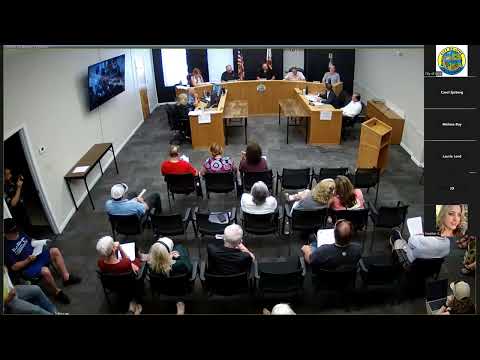
Ione council holds preliminary censure hearing for Mayor Stacy Rhodes amid water, Title 22 and easement disputes
Summary
The Ione City Council on June 4 held a preliminary hearing on a censure request filed by Council member Lisonbee Lafaine against Mayor Stacy Rhodes, with much of the public comment and council discussion focused on alleged undisclosed negotiations over a proposed easement to convey tertiary-treated (Title 22) water and on whether an application tied to US Mine prompted renewed state review of the city's Title 22 compliance.
The Ione City Council on June 4 held a preliminary hearing on a censure request filed by Council member Lisonbee Lafaine against Mayor Stacy Rhodes, with much of the public comment and council discussion focused on alleged undisclosed negotiations over a proposed easement to convey tertiary-treated (Title 22) water and on whether an application tied to US Mine prompted renewed state review of the city's Title 22 compliance.
The hearing followed the city attorney's outline of procedure and allowed each council member to speak to the complaint, then the mayor to respond and public comment before deliberations. Council member Lafaine presented a multi-page complaint she said was prompted by an easement that surfaced on a council agenda; she told the council she had used public records requests to gather supporting documents.
Lafaine said the current Title 22 review by state regulators was triggered not by the city’s plan but by a permit application submitted on behalf of US Mine and that the Amador Water Agency (AWA) project documentation showed the mine could receive tertiary water at no charge while the city continued to pay existing costs for parks. "That Title 22 was not triggered by our plan. Title 22 was triggered by an application submitted to the water resources board on behalf of US mine," Lafaine said.
Mayor Stacy Rhodes strongly disputed the complaint. "What's in the stack of papers is either lies, twisted truth, or just plain ********," he said, and accused Lafaine of negotiating behind the council's back with the golf-course owner and of interfering with sale negotiations. Rhodes described earlier council votes and operational history around irrigation, and he defended his prior positions on wastewater use.
Multiple members of the public urged further investigation into the water and easement issues. Marsha Edick, a private investigator, said she believed there was enough documentary material to justify review by an outside agency such as the attorney general’s office. Larry McKinney, general manager of the Amador Water Agency, was cited in public comments and in exhibits as having communicated about an easement; Lafaine and several commenters said a hearing involving US Mine is scheduled for June 20 with related documents on the State Water Board docket.
The city police chief also spoke during public comment time to dispute assertions in the complaint that his private company had improperly done business with the city. The chief said the city's finance manager confirmed no vendor payments to the company named in the censure document and that department policy permits the city to monitor city email accounts.
Council deliberations focused on three interrelated strands raised in the complaint: whether Mayor Rhodes had a conflict of interest and should have recused himself from discussions tied to his employer; whether the city or US Mine/Amador Water Agency prompted the state to revisit Title 22 compliance; and whether an easement appearing on the turf/irrigation agenda had been properly disclosed to the council.
Procedural motions and votes: the council debated time limits for the mayor/complainant back-and-forth and initially considered a motion to cap the exchange at five minutes; that motion failed and the council proceeded without imposing a council-level time limit on the initial back-and-forth. During deliberations the council considered competing proposals — to retain the same neutral investigator used in a prior censure matter and to take no action. No motion to hire a neutral investigator obtained the necessary majority, and a separate motion to take no action likewise failed to secure a majority. The council did not adopt a resolution of censure or direct a clear next step at the meeting.
The meeting record shows strong public concern about water quality and city transparency. Several commenters referenced historical use of Mule Creek water, allegations that industrial or backwash water had been applied to the Castle Oak golf course, and anecdotal reports of elevated illness clusters near the elementary school; those claims were presented as concerns or as the bases for further investigation, not as adjudicated facts. Lafaine told the council she would pursue the issue further if the council declined action; she cited public records and meeting exhibits as bases for escalation.
The preliminary hearing closed without a final disciplinary action. Council members and multiple public speakers urged the council to shift focus to city operations and infrastructure needs, while others called for independent review of the easement, the Title 22 chronology, and related communications between agency staff and city officials. A public hearing before the State Water Board on the US Mine matter was noted by witnesses as scheduled for June 20, 2025; council members and commenters said the board docket contains language referencing acceptance of tertiary Title 22 water from the city of Ione if coverage and permits are acquired.
The council adjourned the special meeting without adopting a censure resolution or formally directing a specific outside investigation; the record indicates the complaint remains unresolved and may be pursued through other channels by the complainant.