Get Full Government Meeting Transcripts, Videos, & Alerts Forever!
Get email alerts on the Urban Growth Boundary topic
No spam. Unsubscribe anytime.
Commissioners decline a step-down zoning approach and keep urban growth boundary line
Summary
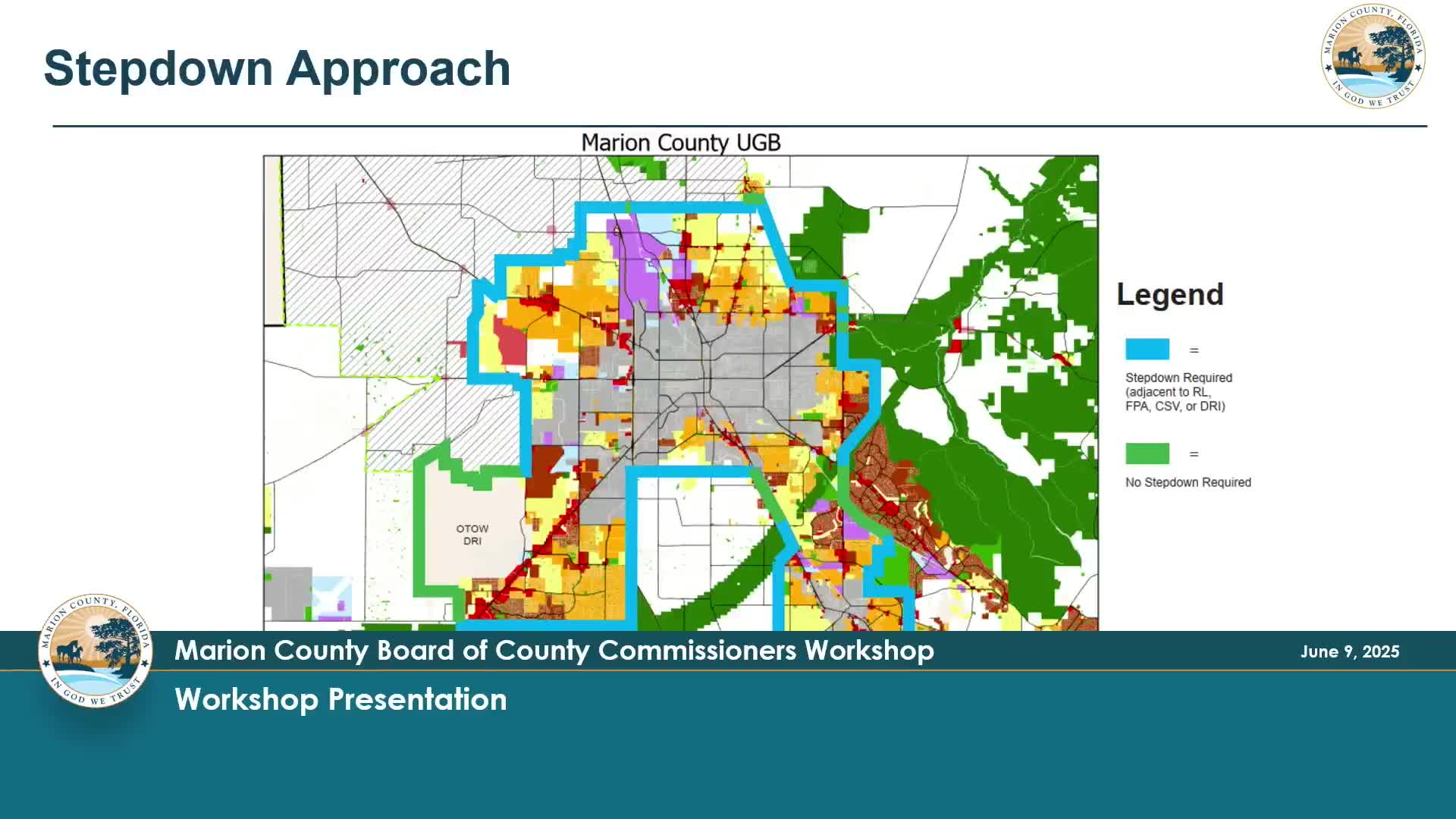
Staff presented three step-down options (100-foot visual buffer, quarter-mile density step-down, and a layered TDR approach); after legal and practical concerns, commissioners voted informally to keep the existing urban growth boundary line and rely on buffer measures and other tools.
Marion County staff presented three options for a step-down approach inside the urban growth boundary — a visual 100-foot buffer, a 100-foot buffer plus a quarter-mile density step-down, and a more restrictive quarter- to half-mile density/TDR approach — and commissioners decided to keep the urban growth boundary line as-is while using other tools such as buffers.
Blair Knighting, staff member, described the three options and emphasized exemptions for parcels of record, family divisions and bona fide agricultural parcels. The most restrictive option would have combined a 100-foot visual buffer, a quarter-mile minimum-density zone, and a half-mile area that limited densities to a medium range unless developers used transfer-of-development-rights (TDRs).
Several commissioners objected to the most complex option. Commissioner Stone said the third option was “too complicated” and noted the county does not yet have a functional TDR program to support that approach. Commissioner Bryant and others favored leaving the current line in place. Legal concerns were also raised: a staff member (Minter) warned that an overly broad restriction might “constitute a taking in some cases.” Blair told the Board the draft language exempted vested rights and family divisions to reduce legal risk.
Board members asked staff to continue work on buffers and the TDR program separately. Commissioners requested that staff return with refinements, community outreach, and a more effective TDR process before attempting an added step-down mapping approach. The Board’s direction amounted to leaving the growth boundary line unchanged for now and addressing edge conditions through other regulatory tools and future work on TDRs.