Get Full Government Meeting Transcripts, Videos, & Alerts Forever!
Get email alerts on the Homelessness Shelter topic
No spam. Unsubscribe anytime.
HSH proposes $101M Prop C interim-housing expansion, reallocates $88.5M to breaking-the-cycle initiative
Summary
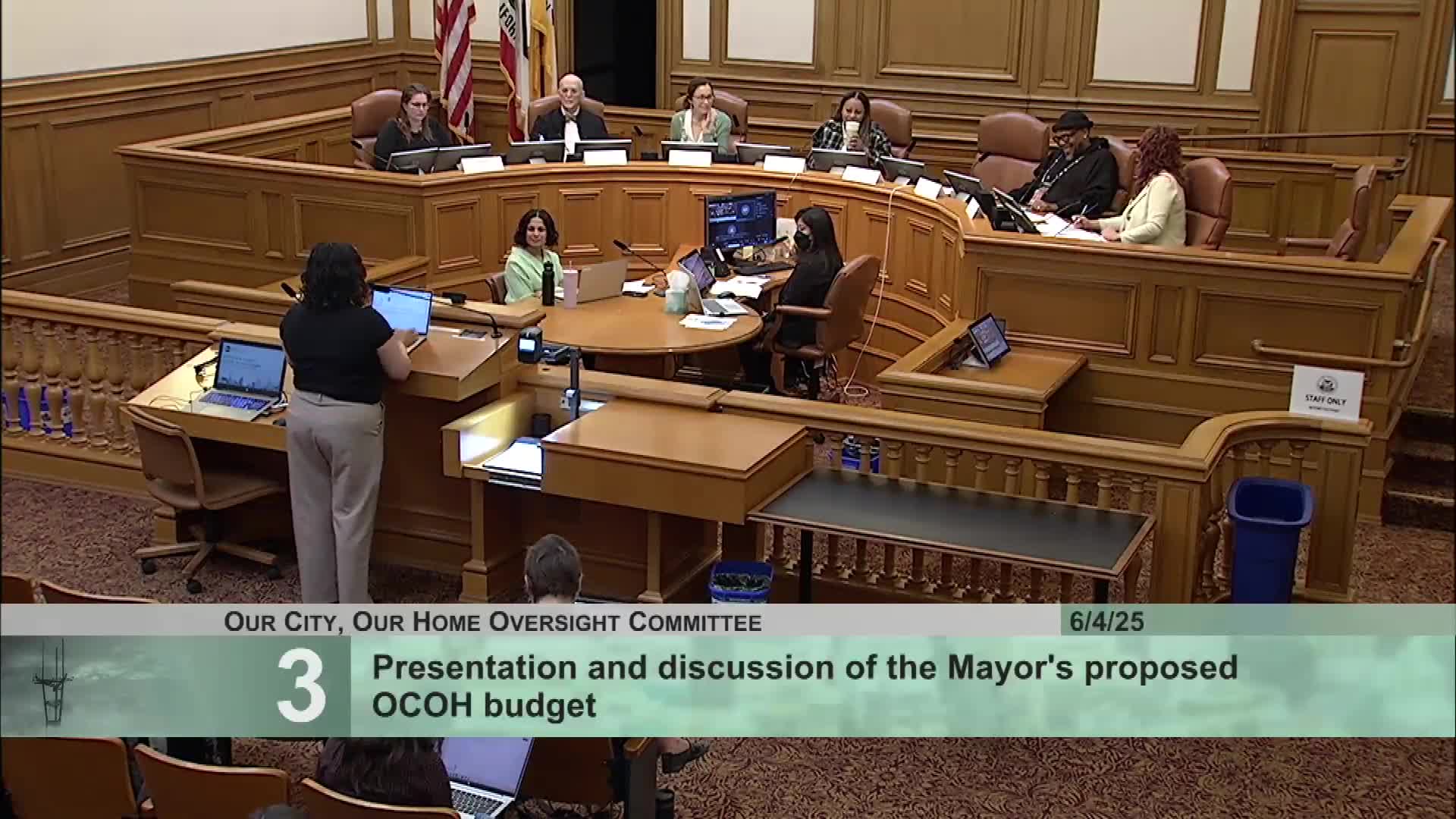
The Department of Homelessness and Supportive Housing presented the mayor's proposed Prop C spending plan on June 4, highlighting a $101 million investment to expand interim housing capacity, a $27 million reserve to backstop federal emergency housing vouchers (EHVs), and a mayoral trailing legislation proposing a one-time reallocation of $88.5 million from unencumbered OCO funds and earned interest.
The Department of Homelessness and Supportive Housing presented the mayor's proposed Prop C spending plan on June 4, highlighting a $101 million investment to expand interim housing capacity, a $27 million reserve to backstop federal emergency housing vouchers (EHVs), and a mayoral trailing legislation proposing a one-time reallocation of $88.5 million from unencumbered OCO funds and earned interest to support the "breaking the cycle" initiative.
The proposal matters because it shifts a substantial amount of OCO funds toward interim-shelter operations and hotel/urgent-accommodation vouchers while relying on reserves and changing how some OCO revenues could be allocated in future years. HSH officials said the allocations preserve previously approved OCO programs but redirect unencumbered balances to a multi-year shelter and voucher expansion.
Christine Roland, budget director for HSH, told the committee the mayor's proposal "includes a $101,000,000 investment in Prop C funding that will go towards a significant expansion of interim housing beds over a 3 year period as part of the mayor's breaking the cycle initiative." Roland said the package funds roughly 570 new interim housing beds, 10 new domestic-violence urgent-accommodation vouchers, and an extension of 130 urgent-accommodation hotel vouchers for families.
Roland described a related $8.2 million addition for 65 new rapid-rehousing subsidies for families, and a $27 million reserve intended to cover emergency housing vouchers currently administered by the San Francisco Housing Authority if federal support lapses after FY 2025–26. She said HSH is projecting that reserve will be enough to cover existing vouchers for roughly one year.
Roland also described trailing legislation included in the mayor's package that would reallocate $88.5 million in unencumbered OCO funds and earned interest to fund the breaking-the-cycle initiative over three years. She said the $88.5 million would be made up of $28.9 million in interest earnings, $56.3 million in housing fund balance, and $3 million from prevention reserves. Roland emphasized none of that $88.5 million would go toward behavioral health; HSH intends it for interim housing beds and hotel vouchers administered through nonprofit provider agreements.
Committee members raised multiple concerns about the reallocation and legality of uses. Member Friedenbach asked for the breakdown of the $88.5 million and whether particular uses — for example, expanded outreach or SFMTA enforcement tied to vehicles — were proper uses of prevention funds. Roland said the administration worked with the city attorney on the legislation and that the new vehicular-homelessness initiative would include problem-solving funding through HSH agreements.
Public commenters at the meeting strongly urged the committee to preserve housing investments rather than shift funds to shelter. Several speakers, including representatives of the Coalition on Homelessness and residents with lived experience, said shelters do not reliably lead to exits to permanent housing and urged more permanent supportive housing and long-term subsidies.
Ending: HSH said the spending plan continues strategic plan investments from prior years while using one-time fund balance and reserves to sustain new work in the near term; the department warned of projected deficits in later out years if additional revenue is not identified. Committee members asked HSH to provide additional details on eligibility, contract timing and planned exits from interim housing as programs ramp up.