Get Full Government Meeting Transcripts, Videos, & Alerts Forever!
Get email alerts on the Mental Health topic
No spam. Unsubscribe anytime.
DPH outlines expansion of behavioral health beds, warns of midterm funding cliff
Summary
The Department of Public Health briefed the Our City, Our Home Oversight Committee on a mayoral budget proposal that adds residential treatment and respite beds and outpatient capacity funded in part by Prop C and one-time balances, but officials warned of a projected funding shortfall in two to three years.
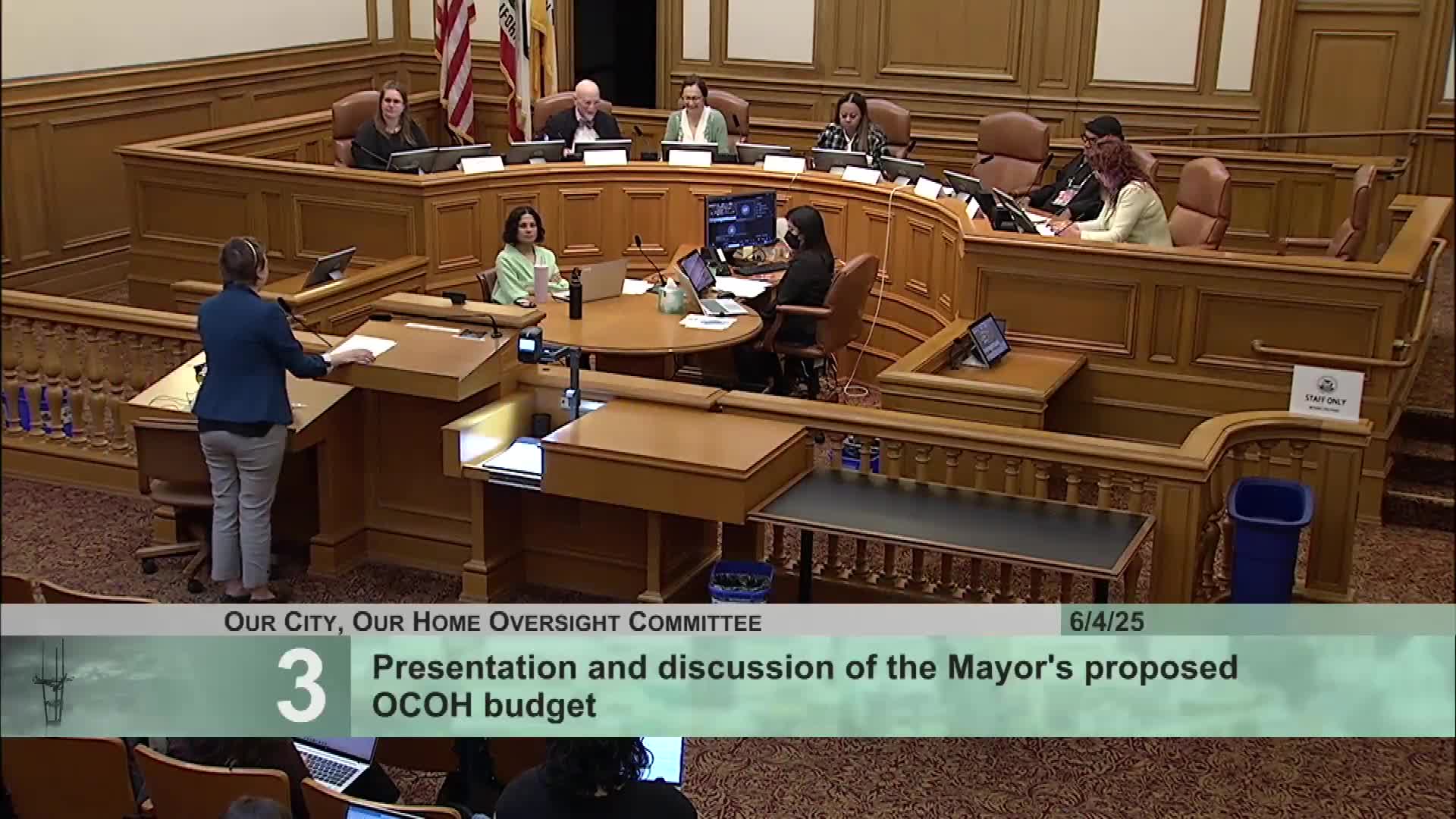
The Department of Public Health presented the mayor's proposed mental health portion of the Our City, Our Home (Prop C) budget on June 4, detailing new investments to add treatment beds and outpatient capacity while cautioning committee members the plan relies on one-time fund balance and creates a funding shortfall in later years.
The presentation matters because it pairs sizeable short-term service expansions with limited operating revenue: DPH officials said the plan commits roughly $30 million over two years to open 180 new residential care and treatment beds and $12 million over two years to increase intensive outpatient treatment capacity and follow-up services, but relies on one-time Prop C fund balance that creates a “cliff” after the budget window.
Emily Gibbs, deputy finance officer for the Department of Public Health, told the committee the mayor's proposal “includes, and these are the 2 year numbers, dollars 30,000,000 to open 180 new residential care and treatment beds,” and described a portfolio that ranges from short-term health respite to longer-term recovery housing. Gibbs said the plan funds the KEEN respite site — a 76-bed site in partnership with Westside Community Services — and the Marina Inn, a 60-bed post-treatment recovery housing program operated in partnership with the Salvation Army.
Gibbs said the budget also supports operating costs for 601 Laguna Street, a 44-bed residential care facility the city is negotiating to acquire and renovate, with an anticipated opening in late 2026. She said acquisition and capital projects in the behavioral health portfolio rely on roughly $60 million in committed acquisition funding and significant state capital awards through Proposition 1, which awarded San Francisco approximately $27.6 million in the first round for behavioral health capital projects.
DPH officials also described leveraging state funds: Gibbs noted a $6.3 million award to reopen 333 Seventh Street as a dual-diagnosis residential facility and $21.3 million to add 57 locked mental health rehabilitation center beds at Zuckerberg San Francisco General Hospital, with timelines stretching into 2026–2027. She said overall the department has been awarded $88 million in state capital funding for behavioral health projects since 2022, and that a second round of Prop 1 applications is due in October.
Committee members asked detailed clarification questions about timelines, operating-fund sources, staffing, and the projected funding cliff. Gibbs said some operating costs will come from the general fund and by maximizing Medi-Cal reimbursement where possible, but acknowledged “this does use 1 time fund balance in the mental health service area to support these existing and new investments, and does lead to a, more significant cliff outside of the budget window.”
Members pressed about staffing and placement pipelines as new beds come online. Gibbs said DPH is reorganizing street teams and expanding pipelines into placements, and that the mayor's “breaking the cycle” initiative seeks a systemwide approach to case management, street outreach, residential capacity and outpatient supports.
Several committee members urged planning now for the projected shortfall. One member said the cliff “needs to be discussed now” so the committee and the mayor can weigh trade-offs before the one-time money is spent.
Ending: DPH closed the clarification portion of its presentation and the committee moved next to the shelter and hygiene service-area presentation from HSH. The committee did not vote on the mental health service-area budget during this clarification-only period. Quotes in this article come from the committee transcript of the June 4, 2025 Our City, Our Home Oversight Committee meeting.