Get Full Government Meeting Transcripts, Videos, & Alerts Forever!
Get email alerts on the Special Session topic
No spam. Unsubscribe anytime.
Leaders say complex health and human services bills are delaying a Minnesota special session; goal is to finish before June 10 to avoid layoffs
Summary
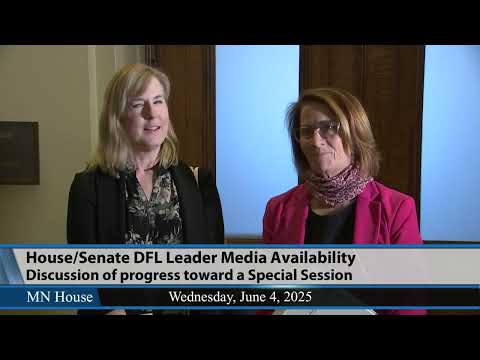
Legislative leaders told reporters the drafting and multi-party review of the health and human services budget bills has delayed posting final language. They said transportation is near complete, leaders hope to hold a one‑day special session as soon as Saturday, and they want to finish before June 10 to prevent additional state layoff notices.
Legislative leaders said the final drafting and review of Minnesota’s large health and human services budget bills is taking longer than expected, and they expect a special session as soon as Saturday to complete work — with an urgent goal of finishing before June 10 so additional layoff notices to state employees are not required.
Speaker 1, a legislator (unnamed in the transcript), told reporters that “for these very long bills, that takes a huge amount of time. It's complicated.” He said the review cycle requires draft language to circulate among House and Senate chairs from both parties and the implementing agencies, with specialists and nonpartisan reviser staff reviewing technical language before a final posting.
The delay matters because the health and human services bills together represent a substantial share of the state budget and affect programs for vulnerable Minnesotans, leaders said. “They're very significant parts of the state budget. I think together, they represent about 20% and growing of the state budget,” Speaker 1 said.
Leaders described the current status and next steps. Transportation language is “very close to wrapping,” Speaker 1 said, but technical wording held up its final posting. Traditionally, the special session agreement lists the specific bills to be taken up once all final texts are posted; leaders said they expect to begin negotiating that agreement after the outstanding drafts are finished. Speaker 1 said leaders will also talk about “items that the tax chairs agreed to” — mostly technical, non‑money provisions — and whether some of those can be added back into the final package.
On timing and personnel impact, Speaker 1 said he expects the special session to be held Saturday if drafts are complete, with a “far outside” possibility of Thursday. He said completing the work before June 10 is important because an earlier round of layoff notices has already been sent to nurses and a wider wave could follow. “We know that nurses received about, I think somewhere between 750 and 950 nurses received notices that were sent to be received on June 1,” he said. He added there are “between 10 and 20,000 employees, I believe, that would be impacted by the next round of layoff notices,” as stated in the meeting.
On the mechanics of a special session, Speaker 1 described the hope that the agreement would constrain proceedings to a single day and reduce overnight floor debates. “The agreement will probably require it to be 1 day. That's the hope that it would be 1 day,” he said, adding a desire to avoid working through the night and to allow time for public comment and press availability prior to floor action. He also noted the formal lengths of a legislative day: “a legislative day goes from 7AM to 7AM.”
Leaders also reviewed the votes they will need to pass bills and to speed procedures. Speaker 1 said, “We need 68 votes in the house and 34 in the senate to pass bills. We need 90 to suspend the rules and speed things up in the house and 45 in the senate,” and described ongoing conversations to line up those numbers within caucuses once final drafts are available.
Asked about whether rollback of a noncompete ban was under discussion, Speaker 1 said, “We are not.” He and other leaders also emphasized that the legislative reviser and nonpartisan staff need time to finalize language without rushing, citing past instances when hurried drafting led to errors. One participant remarked on the work pace and staff wellbeing, noting that adequate rest was important to avoid mistakes.
Leaders contrasted this session with the previous year’s prolonged floor tactics, noting that last year’s minority filibuster included “51 hours on the collected bill,” while this year’s tied control of the two chambers has reduced incentives for protracted partisan obstruction. The leaders said they have been caucusing some bills as they are completed and will resume caucus work and bill-by-bill decisions as the remaining drafts are posted.
Looking ahead, leaders said they will continue negotiating the special session agreement and caucusing completed bills; no final vote counts or specific final texts were presented at this briefing. They emphasized the primary objective of completing key budget bills in time to avoid triggering more layoff notices for state employees.