Get Full Government Meeting Transcripts, Videos, & Alerts Forever!
Get email alerts on the Housing Inclusionary topic
No spam. Unsubscribe anytime.
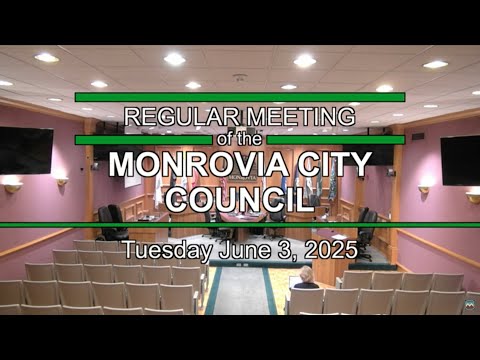
Monrovia council adopts targeted inclusionary housing ordinance, to revisit citywide expansion in six months
Summary
The City Council voted to introduce and waive further reading of Ordinance No. 2025-03, creating an inclusionary housing requirement focused on three high‑density planning areas and establishing alternative compliance and in‑lieu fee options. Council directed staff to return in six months to review expanding the requirement citywide.
Monrovia City Council on Tuesday introduced and waived further reading of an ordinance that requires developers of market‑rate housing in designated high‑density areas to set aside or fund affordable units.
The ordinance, introduced as Ordinance No. 2025‑03, targets projects in Station Square Transit Village, the West Huntington Drive corridor and the South Myrtle Avenue corridor and ties the city’s affordable‑unit requirement to project size and type. The council voted unanimously on a roll call to move the ordinance forward with a directive that staff return in six months to evaluate expansion citywide and to report on implementation details.
Community Development Director Sherry Bermejo said the ordinance is the result of nine months of study, consultant analysis and public input. “Inclusionary housing is a land‑use tool that allows cities to require developers who are producing market‑rate housing units within their community to set aside a percentage of their units as affordable units,” Bermejo told the council. She said the ordinance was designed to be “Monrovia‑centric” and to work with state density bonus law and other incentives.
Under the ordinance text presented to the council: ownership projects would set aside 10% of units at the moderate‑income level; rental projects would follow a three‑tier approach: projects of 5–20 units would set aside 6% of units at low income, projects of 21–49 units would set aside 10% at low income, and projects of 50 or more units would set aside 15% at low income. The draft also allows alternative compliance including off‑site construction, unit conversion and an in‑lieu fee.
Bermejo described the in‑lieu fee as a per‑square‑foot charge: $29.40 per leasable square foot for ownership projects and $24.50 per leasable square foot for rentals in the draft. She gave a scenario: a 5‑unit rental project with 1,500 square‑foot units would trigger an in‑lieu fee “close to $200,000,” while a hypothetical 50‑unit ownership project at that unit size could yield fees “over $2,000,000.” She emphasized that the ordinance requires a developer housing plan and a recorded covenant to secure affordability.
Public speakers supported the ordinance and urged broader reach. Melissa Taylor asked the council to make the ordinance citywide now so it would already apply if future development opportunities arose outside the targeted areas. Carol Daley, who runs a local food program, urged a higher set‑aside for larger projects and said proposed percentages would not meet need for many lower‑income residents. Several speakers emphasized that state requirements and the regional housing needs allocation make local action necessary.
Council members said they supported moving forward, with several urging monitoring and adjustments to avoid unintended consequences. Councilmember comments noted that bundling the requirement with state incentives like the density bonus can change project economics and that staff should monitor counter inquiries and developer feedback. Councilmembers asked staff to return with enforcement details, a fee resolution and a draft housing trust fund mechanism.
The ordinance will be returned for additional procedural steps, including a separate fee resolution to set the final in‑lieu rates and creation of a housing trust fund. Staff said the planning commission previously held a public hearing on the draft and recommended approval.
Why it matters: The ordinance is a new local regulatory tool intended to produce deed‑restricted affordable units and generate funds for affordable housing while directing growth toward transit‑served corridors. The council’s six‑month follow‑up requirement establishes an explicit review schedule to evaluate whether the policy should be expanded beyond the initial targeted areas.
What happens next: Staff will prepare a fee resolution and administrative policies for how in‑lieu fees and off‑site construction will be reviewed and monitored, and the council asked for a six‑month report on implementation and market effects.