Get Full Government Meeting Transcripts, Videos, & Alerts Forever!
Get email alerts on the Cdbg Dr topic
No spam. Unsubscribe anytime.
Houston unveils draft $314 million CDBG-DR24 action plan emphasizing power resilience, emergency vehicles and homelessness services
Summary
The City of Houston presented a draft plan for a $314 million CDBG-DR24 allocation on June 3 that prioritizes backup power for critical facilities, purchases of emergency-response vehicles, and homelessness and shelter services while drawing criticism from council members and community groups for limited direct housing-repair allocations.
City of Houston officials on June 3 presented a draft action plan for a $314 million congressional allocation of CDBG-DR (Disaster Recovery) funds tied to 2024 storms, outlining priorities focused on power resilience for critical facilities, emergency-response vehicles, homelessness services and debris-management investments.
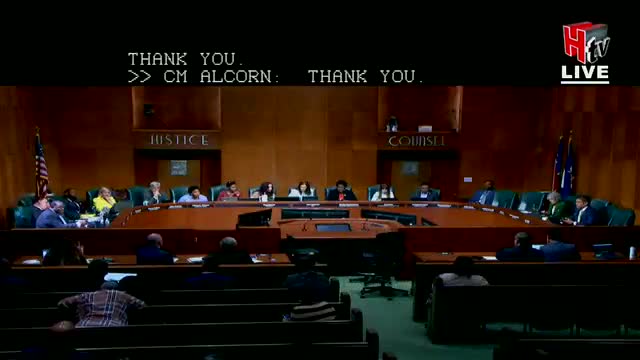
Housing Department Director Mike Nichols told the Budget & Fiscal Affairs Committee that the city requested $305 million and received $314 million as a direct allocation to the city. "We asked for 305,000,000. We got 314, and it's coming directly to the city of Houston," Nichols said. He and deputy director Derek Sellers and Assistant to the Chief of Staff Steven David told the committee the award is not an upfront check but a federal reimbursement grant the city must spend in compliance with HUD rules and documented procedures.
Key elements in the draft plan presented to the committee include: - Power Generation Resilience Program: the single largest proposed share, intended to provide backup generation for water and wastewater facilities, multi-service centers and other critical assets. Officials described the line as "over $150 million" in the draft. - Emergency Response/Public Safety Program: funding for high-water rescue vehicles, ambulances and other public-safety vehicles to increase operational capacity during disasters. - Homelessness and Public Services: a line item presented in the draft for shelter, outreach and supportive services; officials discussed a multi-year spend plan and said the draft included a homelessness allocation in the tens of millions of dollars (committee testimony cited roughly $41 million in some slides and discussions). - Debris repositories and mitigation: proposed purchases and development of permanent staging/repository sites for storm debris and an allocation for vegetation management and debris removal; the draft included figures of roughly $32 million for mitigation-related repository acquisition and about $8 million for vegetation management.
Officials said HUD defines mitigation broadly and requires that CDBG-DR funds adhere to specific rules: a minimum of 70% of funds must benefit low- and moderate-income persons; administrative costs are capped at 5% of the allocation (lower than annual entitlement programs); public services are limited to 15% without a waiver; HUD expects an unmet-needs assessment and strict tiebacks to storm impacts. City staff said HUD had pre-vetted the broad approach and that a request for limited waivers is likely to secure additional flexibility in program design.
Timing and process: HUD published the allocation in January; the city posted a draft action plan and is accepting public comment through June 22. Staff said they requested an extension and expect to submit a final plan to HUD by the July 20 deadline, after which HUD typically takes about 45 days to review. If approved, the city would have up to six years from the grant-execution date to spend the funds; HUD will also require certifications of the city's financial controls and subsequent policies and procedures.
Council members and community speakers raised several concerns and requests during the committee meeting and public comment: - Housing and home repairs: multiple council members and public commenters pressed why the draft allocates little or no direct CDBG-DR24 money to home repair, reconstruction or tenant protections, citing an unmet-need estimate in the draft that listed housing repair and personal-property loss as the largest unmet need. Community groups and residents said homeowners and renters still live with unrepaired roofs and property damage from last year—s storms and urged the city to allocate more recovery dollars to housing stability. - Homelessness linkage: some council members questioned whether homelessness funding is a direct CDBG-DR-eligible response to the storms; city staff argued that disaster impacts and gaps in sheltering during outages and heat events justify public-service investments for people experiencing homelessness. - Waivers and procurement: staff said they are working with HUD on waivers for eligibility and low/mod benefit determinations where benefits are regional rather than strictly within census tracts; they also described parallel procurement steps already taken to expedite generator acquisition and installation while ensuring compliance if HUD requires federal procurement rules. - Operations and maintenance (O&M): council members asked how vehicle and generator O&M will be funded after purchase; officials said federal grant rules do not generally cover ongoing fleet O&M, and those recurring costs would typically be absorbed by city operating budgets or included in long-term maintenance contracts where allowable.
Public engagement: staff opened a comment period (May 23–June 22) and scheduled two virtual public hearings June 10 and June 12; the draft action plan and online surveys for residents and agencies are posted at houstontx.gov/hcdrecovery. Public commenters included housing advocates and residents who asked for larger housing allocations and better outreach, and climate and equity groups who urged stronger mitigation and community participation in plan development.
What officials said about policy trade-offs: Nichols and his team said the city must balance urgency (quick wins HUD will approve) with compliance, noting prior disaster-recovery programs have remaining unspent balances from earlier storms and that the federal agencies have cautioned the city to design programs the city can implement and document successfully. Steven David summarized the approach as "start[ing] somewhere" and seeking public input before finalizing the plan.
Next steps: staff will hold the two public hearings, collect written comments through June 22, refine the draft and present the action plan to full council for approval before submission to HUD on the city—s timeline. Committee members asked staff for additional details on projected equipment counts, generator siting, procurement timelines and options for housing-repair subrecipients, and staff said they will provide those materials as the plan is refined.
(Reporting based on presentations by Mike Nichols, Housing Director; Derek Sellers, Deputy Director; Steven David, Assistant to the Chief of Staff; and public commenters including Zoe Middleton and representatives of local community organizations.)