
Sandpoint council reviews Russell Sports Center finances and four operating options after six months
Get AI-powered insights, summaries, and transcripts
Sign Up Free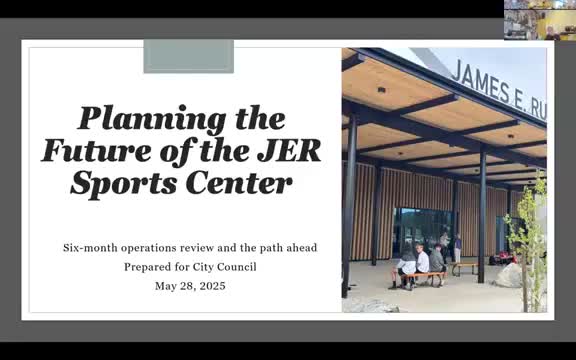
Summary
City staff presented six-month financials for the James E. Russell Sports Center, showing a roughly $101,000 projected shortfall and 54% cost recovery; council and the public weighed four options including staying the course, temporary multi-sport conversion, third‑party operator and minimal hours.
Sandpoint City Council members on May 28 reviewed six months of financial data for the James E. Russell Sports Center and heard public comment on four proposed operating options to address an ongoing operating deficit.
Community Planning and Development Director Jason Welker told the council that the facility, donated by Ginny and Jim Russell and opened Dec. 16, 2024, has incurred roughly $138,000 in operating costs and earned about $72,090 in revenue in its first six months, producing an expected shortfall of about $101,000 over the next year under current assumptions. "We're covering about 54% of the operation cost of this facility using membership and user fees," Welker said, noting that membership retention has been low and that some early startup equipment costs inflated the first months' expenses.
Welker said personnel is the largest expense: the center has carried roughly 130% full‑time equivalent (FTE) staffing on its books early on, including a full‑time facility supervisor and part‑time front‑desk staff. After a recent internal restructuring, he said the facility's full‑time labor charged to the center will be reduced to about 70% FTE beginning in June, producing immediate staffing‑cost savings. He said utility bills and one‑time equipment purchases also contributed to higher early costs.
The presentation gave four broad options for council to consider: (1) maintain current in‑house operations ('stay the course') under a new recreation facility supervisor; (2) adapt the building for multi‑sport use by adding semi‑permanent basketball/volleyball systems and a modular turf field; (3) partner with a third‑party operator (Welker identified the USTA Pacific Northwest as a potential operator for tennis/pickleball programming); and (4) dramatically reduce hours and staffing to lower costs.
Welker provided budget detail: staffing costs charged to the facility were about $95,000 for the first six months; electricity ran roughly $18,000; and other startup purchases (shelving, hardware, office equipment) increased early expenditures. On revenue, Welker reported 51 annual members paying roughly $400–$450 and about 50 active monthly members in May (101 paying members that month, and 238 unique paying members overall since opening). He estimated that raising member retention from the current roughly 35–40% toward 80% would materially improve monthly revenue.
On the multi‑sport option Welker estimated equipment and conversion costs: approximately $54,000 for multi‑sport court surfacing, about $77,000–$80,000 for basketball hoops, a $12,000 volleyball system, roughly $130,000 for a portable turf solution, $8,000 for batting cages and $25,000 for a removable gym‑cover floor for non‑sporting events. He noted an anonymous donor has offered a 50% match for capital outlay. Welker cautioned the city had not modeled the potential loss of tennis/pickleball revenue that could arise from converting one or two courts on a semi‑permanent basis.
Under the third option, Welker described a potential partnership with USTA Pacific Northwest. He said the nonprofit runs municipal facilities elsewhere in the region and could supply program infrastructure (youth and adult lessons, leagues, camps), but he emphasized the council had not received a financial proposal and that a USTA partnership would not necessarily eliminate the city's deficit. "We don't have the details on the financials on that yet," he said.
Council members and the public focused on marketing, programming and user experience as key levers. Mayor Jeremy Grama and several councilors said they want more time and more public input before deciding to reconfigure the facility. Council discussed individually meeting with staff in the coming weeks; Welker said he will return with a proposal in the coming months.
Public commenters — including coaches, youth‑sports organizers and players — largely urged faster and broader programming to increase utilization. Darren Lesch, who runs a local basketball program, offered to rent space immediately and said programming and the people running programs determine whether families return. "If you have the right people running the facilities, making them feel a certain way, building confidence, making them feel good about themselves, they'll never leave," Lesch said. Multiple speakers urged the city to pursue tournaments, youth camps, discounted senior programming (for example, SilverSneakers) and stronger marketing collaborations with local hotels and Schweitzer Mountain Resort.
Several commenters and council members urged the city to explore a limited trial with a third‑party operator before committing to costly capital conversions, while others called for keeping the facility primarily for racket sports as it was designed. Welker said the recreation fund, not the general fund, subsidizes recreation facilities; he said 4.55% of property tax revenue is currently allocated to a dedicated recreation fund (about $231,000 this year) that pays for the city's parks and rec offerings. Council finance staff noted some park revenues flow into the parks capital improvement fund by ordinance; councilors suggested reviewing that ordinance if council elects to reallocate revenue.
No formal motions or votes were taken at the workshop. Council set a public comment cutoff for the evening and encouraged residents to complete a short online survey established during the meeting; Welker said responses would be shared with council the following day.
Welker and new recreation facilities supervisor Ryan Wells were on hand and answered operational questions about internet and recurring monthly utility costs (Welker said the facility's internet will be $395 per month going forward). Finance Director Sarah Linz explained how staff track employee time and the allocation of wages across recreation facilities. Several speakers recommended automating access (key cards), expanding volunteer use and revising membership pricing to improve retention.
The council did not adopt any final course of action. Welker said he would gather additional input from council and the community and return with more detailed financial options and a recommendation in the coming months.