
Ojai planning commission hears months-long discussion about Mallory Way bungalows project; no vote taken
Get AI-powered insights, summaries, and transcripts
Sign Up Free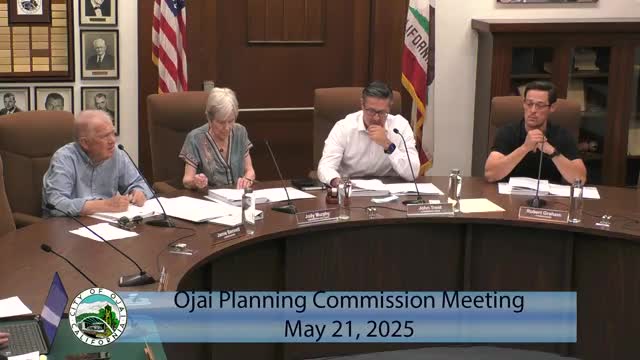
Summary
Mallory Way Bungalows project advances as discussion item, developers and staff seek input rather than approval.
Mallory Way Bungalows project advances as discussion item, developers and staff seek input rather than approval.
The Ojai City Planning Commission on May 21 heard a staff presentation and extensive public comment on a proposal for 58 units at 412 Mallory Way, described by Community Development Director Lucas Seibert as “the Mallory Way Bungalows project” and “a discussion item only tonight.” The project is being pursued under a settlement agreement the City Council approved in December 2023 and would preserve 25 existing bungalow units on-site while adding new single‑story modular units and a trail through the site.
Why it matters: the proposal intersects housing, historic preservation and environmental protections in a densely developed neighborhood. Commissioners, nearby residents and Historic Preservation Commission members pressed the applicant and staff for more detail about parking supply, creek and watershed effects, wildfire evacuation and how new modular housing would relate to the site’s historic motor‑court character.
The developer team headed by Jeff Becker described the plan as a largely single‑story development using prefabricated units. Becker said the proposal includes on‑site parking that the team counts as 66 spaces (the applicant counted 63 standard spaces plus three ADA spaces) and said the design approach aims to limit two‑story buildings to protect neighborhood scale. Lucas Seibert told commissioners that because the project qualifies for state density bonus law, state parking ratios apply and the staff report identifies 63 parking spaces to meet that standard; the city’s baseline multi‑family requirement would otherwise be higher.
Public speakers voiced repeated concerns about drainage, habitat and noise. Anita Graham, a neighborhood resident, told the commission the area includes a creek and connected watershed she called part of Stewart Canyon and warned, “Once construction equipment moves in and begins to work, the watershed will be irrevocably harmed.” Several residents living in the existing Mallory Way cabins said the project risks eroding the site’s quiet, dark‑sky character and could increase traffic and parking pressure on narrow local streets.
Historic Preservation Commission members who reviewed the project in March urged retaining the central motor‑court courtyard and preserving the visual character of the original bungalows. Bridal Akins, a Historic Preservation Commission member, summarized the HPC votes and said the commission recommended that the city council designate the Mallory Way cottages as a local landmark and pursue a Mills Act agreement to support rehabilitation while keeping the central courtyard open.
Staff and the applicant addressed technical topics raised by the public. Seibert said the public land identified in the settlement is a Mallory Way “paper” street roughly 52 feet wide and 831 feet long; the developer proposes to deed only part of that strip to the city, keeping the remainder with the project. Civil and landscape design representatives said parking areas are proposed with permeable materials where possible, walkways will include decomposed granite and ADA routes will be concrete, and the new modular units would be elevated on foundations or piles so permeable ground remains beneath them.
On trees and habitat, landscape architect Bill Mould said the site contains about 88 trees, about 31 of which the current design would remove; most removals are non‑oak species and 1 protected oak would be removed. The design team proposed planting approximately 31 new native trees, likely oaks, in replacement and said irrigation would be drip‑based. The team also noted Ventura County fire standards that constrain planting near building faces and drive lanes.
Commissioners pressed staff on what conditions the city can impose. Commissioner discussion highlighted how California’s density bonus (Government Code section 65915) and the Housing Accountability Act limit local authority to require additional parking or conditions that would render an affordable housing project infeasible. Seibert summarized density bonus mechanics for the commission and said the project’s allocation of 5 very‑low and 5 moderate‑income units triggers state density bonus benefits; commissioners asked staff to return with a clearer breakdown of how the parking ratio was computed under state law.
Outcome and next steps: no formal action was taken. Staff and the applicant said they would continue to refine the design based on the commission’s input, work with state resource agencies to determine whether the drainage feature is regulated, and continue outreach. Seibert told the commission the item will return as a publicly noticed hearing and that staff anticipates returning within the timeline required by the settlement process. The commission requested additional follow‑up on parking mitigation options (including curb controls and permit parking), evacuation/evacuation access planning for the paper‑street units, and clearer illustrations showing orientation and potential two‑story tradeoffs.
Key details: the proposal is for 58 units on roughly 3.6–4 acres (site currently 3.58 acres before partial deed transfer), preservation of 25 existing bungalows on-site, a density cap of 58 units in the settlement, unit sizes about 500–600 square feet, proposed parking cited by staff as 63 spaces (density bonus ratio) and by the applicant as 66 (63 plus three ADA), and an affordability set‑aside noted in the settlement as 5 very‑low‑income and 5 moderate‑income units. Commission and public comments cited storm drain/creek connections downstream toward Quail Oaks and Los Padres National Forest and urged careful biological and drainage review.
Evidence in the meeting: staff opened the agenda item with Lucas Seibert’s presentation and repeatedly clarified that the meeting was an input session, not a formal hearing. Public commenters included tenants of the Mallory Way cabins as well as adjacent homeowners and Historic Preservation Commission members who recommended keeping the central courtyard. Staff and the applicant agreed to pursue follow‑up analysis on creek jurisdiction, parking, and design refinements before the project returns for formal action.