Get Full Government Meeting Transcripts, Videos, & Alerts Forever!
Get email alerts on the Land Development Code topic
No spam. Unsubscribe anytime.
Planning board unanimously recommends clarifying permit rules: phasing plans, violations, LLC ownership and 90-day extension
Summary
The Bangor City Planning Board unanimously recommended that the City Council amend the land development code to clarify land development permit rules, including phasing plans, a bar on applicants with outstanding notices of violation, and a 90-day post-expiration extension window.
The Bangor City Planning Board unanimously recommended that the City Council amend the land development code to clarify requirements for land development permits, adopting three principal changes: (1) require phasing plans for developments that will be occupied in phases, (2) prevent applicants with outstanding notices of violation from obtaining new permits, and (3) allow a 90-day period after permit expiration to submit an extension application while preserving other requirements.
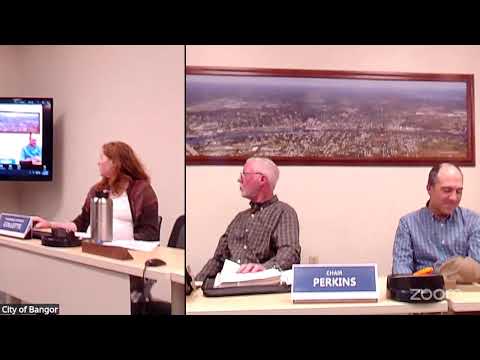
Planning Officer Anya Collette described the three proposed changes and why staff brought them to the board. Collette said the phasing-plan requirement is aimed at projects — such as townhouse developments sold unit-by-unit — where partial occupancy could occur before site improvements are completed. She said the plan would “show us when the site improvements are gonna be completed, you know, before they get those certificates of occupancy.”
On preventing applicants with outstanding notices of violation from receiving new land development permits, Collette said the city’s process would check existing records when an application is filed. “It would be known. So it would be worth their — they’ve been given a notice of violation. So it’s on paper that they have these outstanding,” she said. The board asked whether that check would identify violations for owners who form new limited liability companies. Collette replied the submission requirements would require a list of owners and that staff would check whether those owners have outstanding violations; she compared the approach to existing short-term rental rules.
The amendment would also add flexibility on permit expiration: instead of requiring applicants to apply before a permit expires, developers would have 90 days after expiration to apply for an extension while other rules remain in force. Collette also noted that when ownership changes and a bond is associated with a project (for example a solar installation), the new owner would need to provide a new bond; subdivisions returning after ownership change would still require Planning Board review and re-endorsement of the plan.
Board members asked follow-up questions about how staff would identify outstanding notices of violation, whether the rule would be retroactive to existing notices, and how LLC ownership would be handled; Collette answered that record checks occur at the application stage and that outstanding notices still outstanding at the time of application would block the permit until resolved.
No members of the public provided comment in person or on Zoom. After discussion the board moved and unanimously approved a recommendation of “ought to pass” to the City Council; the board recorded yes votes from Michael Basinet, Jonathan Boucher, Ted Brush, Tricia Hayes, Ken Heung, Janet Jonas and Chair Reese Perkins. Staff said the item will proceed to the City Council for final action.
The proposed changes are intended to strengthen enforcement of the land development code and reduce opportunities for applicants to avoid enforcement by creating new entities. Planning staff noted the approach mirrors tactics used in other communities and aligns with existing submission requirements for ownership disclosure.