Get Full Government Meeting Transcripts, Videos, & Alerts Forever!
Get email alerts on the Public Comment School Boards topic
No spam. Unsubscribe anytime.
Senate committee advances bill to guarantee public comment at school board meetings
Summary
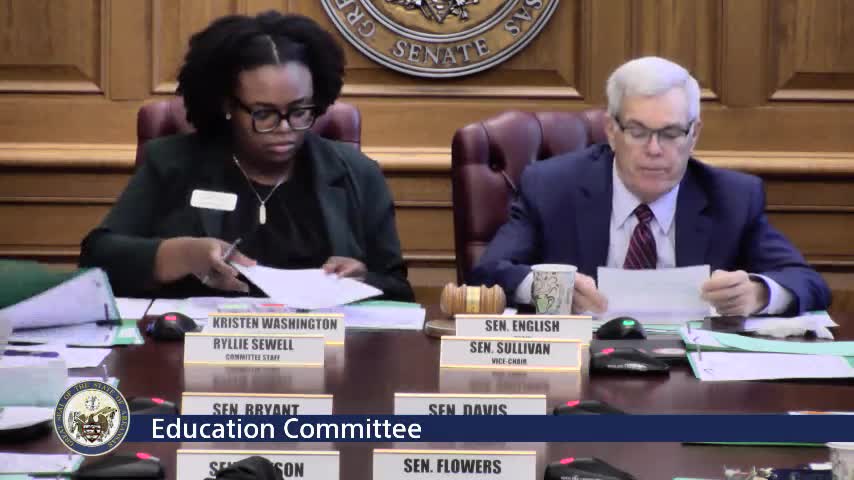
The Senate Education Committee voted to advance Senate Bill 90, which would require school districts to provide a public comment opportunity before business sessions while allowing districts to set reasonable procedural limits.
Senate Bill 90, authored by Sen. Jane English, would require every public school district to provide an opportunity for members of the public to speak before the start of the business portion of a school board meeting while permitting districts to set time and decorum rules.
Proponents said the measure restores a baseline of transparency and public access in local school governance. “People really need an opportunity to be able to voice their opinion and to be heard,” Sen. Jane English said in opening remarks, noting the bill allows districts to determine time limits and excludes comments about personnel or individual students.
Supporters at the committee hearing described local examples where public comment was restricted or made difficult. Karen Maynard, a member of the Pulaski County Special School District board, told the committee her district allows three-minute public comments and posts a sign-up sheet; she said that access should be available in other districts as well. Parent and community speakers, including Missy Bosch and Kimberly Leedy, testified that they and other parents have struggled to get time to speak at some school board meetings and said SB 90 would address that inequity.
Opponents and cautious supporters asked for guardrails to prevent meetings from becoming unruly. Sen. Murdock said the version of the bill before the committee lacks a “filter” and warned that unregulated public comment can cause disorder in a full meeting. Superintendents and school administrators at the hearing, including Jared Cleveland of Springdale and Superintendent Bridal Duffy of Alma, said their districts value public input but described “bad actor” scenarios during the COVID era that made managing meetings difficult. Mike Hernandez of the Arkansas School Administrators Association suggested restricting speakers to residents or district stakeholders as one option to reduce outside disruption.
Courtney Salas Ford, chief of staff for the Arkansas Department of Education, told the committee the department currently reviews school district websites for required policy postings but does not have authority to approve or disallow specific district public-comment procedures. She said SB 90 would give the department the authority to confirm districts have a policy providing the public an opportunity to speak, though it would not authorize the department to set time limits or residency requirements.
Committee members debated trade-offs between statewide minimum access and local control over meeting management. Several senators said they support public comment but want clearer guardrails or training for boards to manage decorum; sponsor English and others said they are open to drafting clarifying language.
Following public testimony and committee discussion, the sponsor moved the bill and the committee advanced SB 90 on a voice vote. The transcript records a motion “do pass,” a second, and a voice vote; names and a roll-call tally were not recorded in the hearing audio.
If enacted, SB 90 would require school boards to provide an opportunity for public comment before the business agenda while allowing boards to adopt reasonable procedures covering time limits and prohibited topics (personnel and matters concerning individual students). The Department of Education told the committee it would be able to verify districts had such a policy but would not have authority under the bill to set specific procedural details.
Supporters said the bill would remedy inconsistent local practices that, they said, impede parents and taxpayers from raising concerns. Critics and some administrators urged additional language on residency, time limits and training to avoid chaotic meetings and to protect student privacy and personnel due process.
The committee action advances the bill to the next legislative stage; no effective date or implementation details beyond those in committee testimony were specified during the hearing.