Get Full Government Meeting Transcripts, Videos, & Alerts Forever!
Get email alerts on the Solar Development topic
No spam. Unsubscribe anytime.
Planning commissioners forward comments on proposed 60‑MW Moore Solar project after technical review
Summary
County planning staff and the applicant described a 60‑megawatt solar installation on Moseywood Road; staff flagged multiple engineering, stormwater, wetland and access issues and the commission voted to forward comments to Kidder Township.
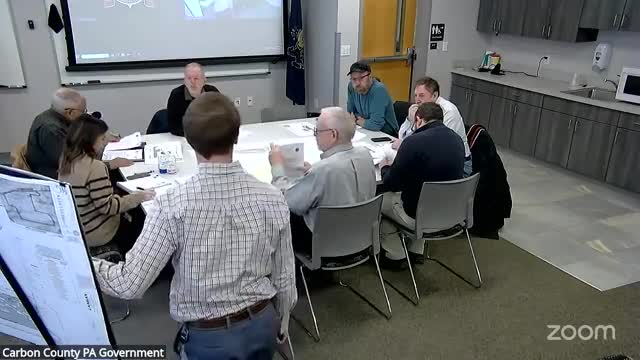
Ben Zito, an engineer with Langan Engineering, told the Carbon County Planning Commission that he was representing Moore Solar LLC and gave an overview of a proposed 60‑megawatt solar development on Moseywood Road. “It is a 60 megawatt … solar development. It’s taking access off of Moseywood Road,” Zito said, describing a plan that would use an existing dirt road improved to a 20‑foot‑wide gravel emergency access and include inverter pads, a substation and an 8‑foot fence around the site.
Zito said the project team planned to limit grading and avoid wetlands and streams within the panel area. “We’re minimizing disturbance to woodlands, wetlands, etcetera,” he said, and described a seeded deep‑rooted meadow mix beneath panels intended to reduce erosion. He said pile foundations would be sized based on geotechnical recommendations, and that noise from inverters was expected to be limited by vegetation.
County planning staff reviewed the application and provided an extensive written technical comment list to the commission. Staff noted the project site maps and plan sheets were inconsistent with ordinance and subdivision plan requirements and flagged multiple items that must be resolved before land‑development approval. Staff cited local zoning provisions that govern commercial solar in Kidder Township (including references in the transcript to zoning sections 180‑17, 180‑23 and ordinance 192 dated 09/27/2022) and a range of conditions that the township requires for conditional use and land‑development approval.
Among the technical and regulatory items staff asked the applicant to address were: obtaining required state and federal permits and documentation (including PADEP approvals, MPDES/NPDES permit where applicable, and the Army Corps jurisdictional determination referenced in the file); clarifying stormwater management design and providing infiltration testing and operation‑and‑maintenance and funding assurances; adding a traffic travel plan and an assessment of township road conditions and financial assurance for any damage from construction traffic; providing detail on culvert/box‑culvert profiles and verifying structural adequacy for construction vehicles and fire apparatus; completing required biological and PNDI (PA Natural Diversity Index) reviews including seasonal surveys noted as pending; and providing a decommissioning/security agreement in a form acceptable to the township.
Staff also noted zoning‑level requirements described in the review: evidence of insurance (minimum amounts referenced in the staff comments), documentation of anticipated glare and remedial measures, certification of equipment and design standards, visible warning signage for transformers/substations, and an emergency response plan coordinated with local fire officials. Staff recommended the township require the applicant to fence wetland buffers and to demonstrate that no more than a limited percentage of wetland buffers would be disturbed in compliance with the ordinance language cited.
During discussion commissioners and staff asked questions about the project footprint and tree clearing. Zito stated the overall property is “1,643 acres” and that the solar facility itself is “about 59 acres.” He said tree clearing would be limited to the panel areas and that the design “bobs and weaves” to avoid wetlands and streams within the panel area. The applicant said they had met with PADEP and that state permits were being pursued but not yet issued.
Commissioners asked for clarification about fence height and style after township concerns were raised; Zito said the fence would be an 8‑foot fixed (non‑chain link) game fence without barbed wire. Staff reiterated the need to supply an engineering profile for existing culverts and box culverts and to demonstrate adequacy for anticipated construction and emergency vehicles.
After the technical presentation and review, a commissioner moved that the Planning Commission forward the staff comments to Kidder Township and other relevant parties for their consideration; the motion was seconded and passed with the recorded voice vote of “ayes.” The action was limited to forwarding the county’s review comments — no land‑development approval was given by the commission at the meeting.
Why this matters: County planning review does not approve construction but identifies statutory, engineering and environmental issues that local boards and applicants must resolve. For a utility‑scale solar project, unresolved items such as stormwater controls, wetland buffer protections, traffic impacts, seasonally timed biological surveys and financial assurances for road repairs and decommissioning can determine whether and how a township grants conditional use or land‑development approval.
Next steps: County staff requested revised plans and documentation addressing the items in its review, and the commission’s motion forwarded those comments to Kidder Township and the applicant for action by the township and for further resubmission if necessary.