Get Full Government Meeting Transcripts, Videos, & Alerts Forever!
Get email alerts on the Civil Rights And Equal Protection topic
No spam. Unsubscribe anytime.
Senate committee advances SB 3 restricting race- and ethnicity-based preferences; public commenters urge rejection
Summary
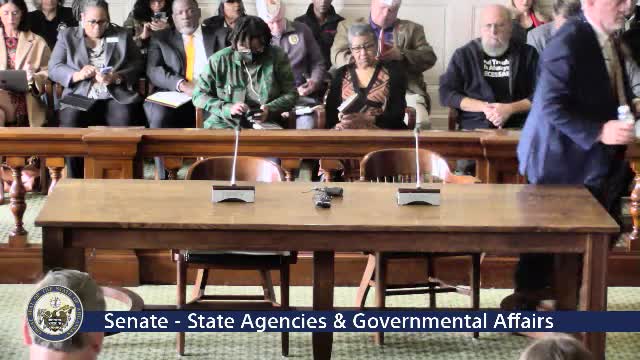
The Senate Committee on State Agencies & Governmental Affairs advanced Senate Bill 3 after extended questioning of sponsor Senator Sullivan and more than two hours of public testimony, much of it in opposition.
The Senate Committee on State Agencies & Governmental Affairs advanced Senate Bill 3 after extended questioning of sponsor Senator Sullivan and more than two hours of public testimony, much of it in opposition.
Senator Sullivan, the bill's sponsor, told the committee SB 3 is intended to prohibit government entities from discriminating for or against people on the basis of race, color, ethnicity or national origin in the areas of education, employment and procurement. "This legislation applies only to government agencies in areas of education, employment, and procurement," Sullivan said, adding that the measure does not affect veterans: "The General Assembly does not intend for this act to affect any preferences provided to veterans under the law based on their status as a veteran." He also told the panel he had discussed the draft with the attorney general and that the office was prepared to defend the bill in court.
Sponsor's description and contested provisions
Sullivan said the bill replaces broad, generic references to "civil rights" with the more specific language "desegregation and nondiscrimination," and removes statutory references to programs that explicitly use the term "minority," substituting language tied to "critical needs" or "need-based" criteria. He argued these changes reflect recent federal executive actions and a focus on need rather than race-based preferences. "The term critical need is inclusive of minorities. It's not eliminating minorities, it's making that population larger not smaller," Sullivan told the committee.
Several senators pressed Sullivan on concrete effects. Senator Tucker asked whether the measure would eliminate minority recruitment plans for teachers and retention programs in higher education; Sullivan characterized those programs as "preferential treatment" and said the bill would end programs that explicitly give preference based on protected categories. Senator Clark said he supported the bill's intent but worried that removing targeted minority teacher recruitment could hinder efforts to increase representation of Black male teachers, a group Clark said is linked to improved outcomes for some students.
Public comment: organizations and individuals oppose the bill
More than a dozen members of the public testified. Many organizations and speakers urged the committee to vote no, saying SB 3 would erase programs designed to expand educational and economic opportunity for historically underserved groups.
- Lance LaVar (private citizen, formerly with the Department of Education) said teacher-recruitment and retention plans were designed to widen candidate pools and ensure hiring of the most qualified person from a deeper, more diverse pool. "The plan was designed to ensure that we reach out and make sure our pool is deep enough, and then we hire the most candidate from that pool. Our pool is too shallow," he said.
- Robert Steinbach, a law professor testifying in his individual capacity, supported the bill and said similar language has existed in other states; he also argued that injunctive relief against the state is legally available in appropriate cases.
- Austin Porter Jr., a civil-rights attorney, and witnesses from the Arkansas NAACP, Arkansas Advocates for Children and Families, Arkansas Civic Action Network and others testified against the bill. Porter described the measure as a "wolf in sheep's clothing" and argued it would remove tools that helped diversify education, government hiring and economic programs. Maricela Garcia of Arkansas Advocates for Children and Families cited research linking exposure to teachers of color with improved long-term outcomes for students.
Speakers representing veterans and veteran organizations also attended. Sponsor Sullivan repeatedly emphasized that the bill explicitly preserves preferences for veterans.
Legal and procedural notes
Committee members asked whether the bill duplicates or conflicts with existing state law, including the Arkansas Civil Rights Act. Sullivan said the language restates protections and enables a private civil action for injunctive relief; he noted the attorney general's office had reviewed the bill and was prepared to defend it in court. Several committee members raised questions about sovereign immunity and whether attorney's-fee awards would be available in suits against the state; Sullivan said courts would determine those issues on a case-by-case basis.
Committee action and next steps
After discussion and public testimony, Senator Sullivan moved SB 3. Senator Payton seconded. The committee approved the bill by voice vote.
The committee record shows extensive opposition from civil-rights and community groups, educators and other speakers who warned the bill could eliminate minority-focused scholarships, recruitment and retention programs, and cultural or community institutions that rely on targeted funding. Supporters framed the bill as a restoration of "merit" and race-neutral, need-based processes; opponents said it would remove tools aimed at remedying long-standing disparities.
Votes at a glance: The committee advanced SB 3 on a voice vote; motion by Senator Sullivan, second by Senator Payton. Exact yea/nay counts were not recorded in the transcript.
What to watch next: The bill will move to the Senate calendar for further consideration and possible amendment. Committee debate and the public record indicate that future floor debate will focus on whether the bill removes targeted programs (teacher recruitment, minority scholarships, minority- and women-owned business certification) and on potential legal challenges if the measure becomes law.