Lifetime Citizen Portal Access — AI Briefings, Alerts & Unlimited Follows
Senate committee rejects 30‑mile ban on crypto mining near five Arkansas military sites
Loading...
Summary
Senator Ricky Hill’s proposal to bar digital asset mining within 30 miles of five major military installations drew testimony from industry representatives and national‑security proponents and failed on a roll‑call vote after committee debate and public comment.
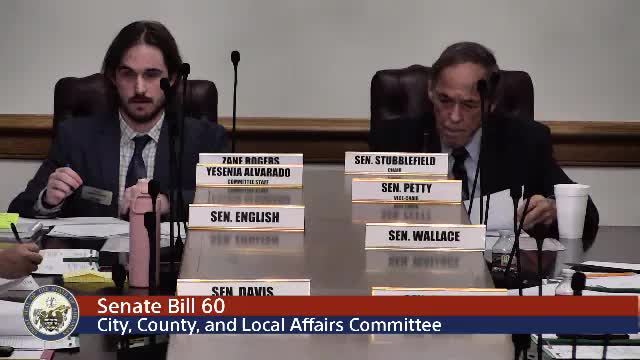
Senator Ricky Hill introduced Senate Bill 60 in the City, County & Local Affairs Committee — Senate, proposing to prohibit digital asset (crypto) mining facilities within a 30‑mile radius of five listed military sites in Arkansas. The list named Little Rock Air Force Base, Camp Joe T. Robinson, Ebbing Air National Guard, Fort Chaffee and Pine Bluff Arsenal. The committee considered the bill, heard testimony from industry and stakeholders, and the motion to pass as amended failed on a roll call.
Hill said the measure was a narrow safety provision and not an attack on the crypto industry. “This is, senate bill 60, which is a crypto bill. I know we've all debated crypto left and right… What I'm here to discuss today is a little safety mechanism to put in every crypto,” Senator Ricky Hill said, adding that Arkansas covers “roughly 53,000 square miles” and that the bill would create buffer zones around the five facilities.
The bill’s main operative elements as discussed included: a 30‑mile exclusion zone around the five named facilities; a cross‑reference to permitting language the committee earlier placed under the Oil and Gas Commission’s rulemaking; and an emergency clause asserting risk from digital asset mining, including unspecified threats to national security.
Why it mattered: supporters framed SB60 as a precaution to protect military personnel and installations from potential risks tied to digital‑asset operations; opponents warned the bill could unintentionally block existing and prospective private investment and that federal authorities or the Department of Defense had not presented a documented threat.
Industry witnesses told the committee the bill, as amended, would create practical and legal problems. Bill Vickery of Capital Advisors Group, representing the Arkansas Blockchain Council, said the amended text and the way it references permitting could make compliance impossible for existing operations because the Oil and Gas Commission has not finished promulgating the rules that would allow issuance of the permits the bill references. “Unless the digital asset mining business was issued a permit by the Oil and Gas Commission on or before 12/31/2024, they shall not operate,” Vickery told the committee, saying the permit framework the bill depends on “did not exist then, and they do not exist now.” He also warned of local economic impacts where mining operations pay sales tax on consumed power.
Bud Cummings, an attorney for the Arkansas Crypto Mining Association, said he shares security concerns in principle but urged the committee to seek federal or Department of Defense findings before imposing broad prohibitions. “Until somebody tells me there's a threat, then I'm more concerned about having a system… where people — this is a growing industry and we want Arkansas to get its share of the investment,” Cummings said, adding concerns about retroactive enforcement and takings if permits could later be revoked.
Jerry Lee Bogart, who identified himself as an investor in AI development, urged caution about measures that could deter large‑scale AI or data center investment. He described Arkansas as “uniquely positioned to be a global participant” in AI development and warned that overly broad exclusion zones might preclude future multibillion‑dollar projects.
Committee members asked about the scope of the five listed sites and whether the measure would affect every National Guard armory; Hill clarified the proposal targeted the five named major military facilities only. Members also pressed whether the federal government or base commanders had requested such a buffer; witnesses and the sponsor said they had not received formal requests from the Department of Defense or base commanders and that such federal input had not been provided to the committee.
The committee took a motion to “do pass as amended.” After a voice vote the chair directed a roll call. The transcript records the motion failed and the chair announced, “The bill fails.” The committee announced a roll‑call result at the meeting; the transcript records the outcome as a failed motion (announced as failing on the record). The transcript does not provide a complete, unambiguous listing of each senator’s vote within the recorded excerpt.
The discussion also touched on related policy questions that the committee did not resolve at the meeting: how state permitting (the Oil and Gas Commission) interacts with the statutory language, whether a state‑level exclusion can meaningfully address threats that originate offsite or overseas, and the energy and infrastructure implications if Arkansas seeks to attract large AI or data center projects requiring significant power.
The committee moved on to other business after the SB60 vote; no new direction or implementation motion related to SB60 was adopted that day.
Ending: With SB60 defeated, supporters said they remain concerned about protecting installations and suggested further work to narrow options; opponents urged coordination with federal authorities and caution about economic consequences. The committee record shows the topic drew extended questioning and public testimony and may reappear in future sessions.