Get Full Government Meeting Transcripts, Videos, & Alerts Forever!
Get email alerts on the Right To Try Individualized Treatment topic
No spam. Unsubscribe anytime.
Senate advances bill allowing individualized investigational treatments under federal oversight
Summary
The Senate Public Health, Welfare and Labor Committee unanimously advanced SB136 to create a pathway for individualized investigational treatments for patients with life‑threatening or severely debilitating conditions, requiring review at federally certified facilities and making clear Medicaid is not compelled to pay.
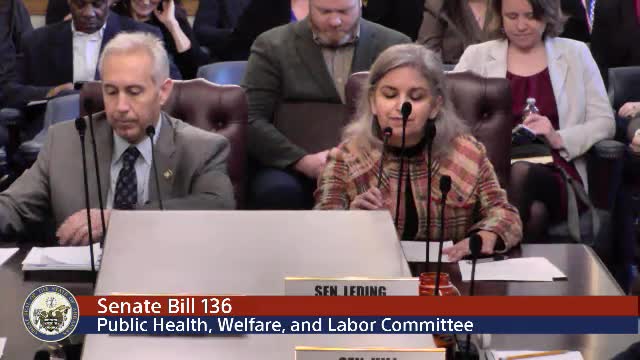
The Senate Public Health, Welfare and Labor Committee advanced Senate Bill 136 on a voice vote after testimony from a national policy advocate and questions from several senators.
The bill creates a state law pathway for an “individualized investigational treatment” — a drug, biologic or device produced for a single patient — to be used for Arkansans with life‑threatening or severely debilitating illnesses, with specified protections tied to federally certified institutional review processes.
“Imagine that there’s a new treatment for a rare disease that’s custom made for you based on your own genetic profile,” Naomi Lopez of the Goldwater Institute told the committee in support of SB136. Lopez described the bill as an update to Arkansas’ earlier Right to Try statute and said it would add protections tailored to newer therapies such as gene treatments.
Sponsor discussion focused on the safety and oversight built into the proposal. The bill limits eligible facilities to those holding a federal wide assurance, a certification under the U.S. Department of Health and Human Services that governs human‑subjects research and the institutional review boards (IRBs) that oversee such work. Committee members repeatedly asked whether providers, insurers or Medicaid would be required to pay for individualized treatments.
Vice Chair Wallace said the bill’s final section “does not require the Department of Human Services or the Arkansas Medicaid program to provide additional coverage for an individualized investigational treatment,” and Naomi Lopez confirmed insurers and public programs are not compelled by the bill to pay. The bill also requires informed consent that specifies costs for the patient before a treatment proceeds.
Committee members pressed for clarity on hospice, licensed providers and how IRBs would vet protocols. Lopez and other witnesses explained that treatments under SB136 would proceed only at entities with federal wide assurances and that institutional review boards could decline to permit a given protocol.
Senator Payton moved the bill do pass; the committee seconded the motion and approved SB136 by voice vote.
The bill’s sponsors said the law would not change Arkansas’ earlier Right to Try provisions but would add a physician‑directed, facility‑reviewed option for cases where an individualized therapy may be the only option.
The committee recorded no formal roll‑call tally in the transcript; the motion passed on unanimous voice vote.