Get Full Government Meeting Transcripts, Videos, & Alerts Forever!
Get email alerts on the Public Health topic
No spam. Unsubscribe anytime.
Committee backs bill to allow AED directional signage on state highways; amendment delays start for DOT coordination
Summary
Senate File 1395 would allow signage directing the public to externally mounted automated external defibrillators (AEDs) and requires costs to be paid by qualifying participants; an A4 amendment added criteria, assigned location decisions to road authorities and set an Oct. 1, 2025 effective date to permit Minnesota DOT coordination.
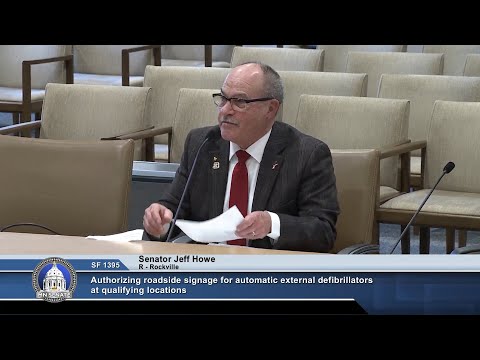
The Minnesota Senate Transportation Committee on Feb. 17 recommended Senate File 13 95, as amended, to pass and referred it to the Senate committee on state and local government. Senator Howe sponsored the bill to authorize standardized directional signage for externally mounted automated external defibrillators (AEDs) so the public can locate them outside buildings after hours.
Witness Rich Finice, founder of Advocates for Health, described his organization’s ‘‘AED smart monitored’’ outdoor cabinets and said local governments and nonprofits have placed exterior AEDs but face limits placing signage on state and federal highways. Finice said his group typically works with city, county and township engineering departments to mount directional signs on existing sign structures and that similar wayfinding signs are used for food, gas and lodging on highways.
The committee adopted an A4 amendment that reorganizes qualifying-participant criteria, clarifies that qualifying participants must meet registration, notice and inspection requirements, and directs the relevant road authority to determine suitable locations and an appropriate number of signs. The amendment also moved the effective date from immediate enactment to Oct. 1, 2025 to allow the Minnesota Department of Transportation to incorporate signage into the Minnesota Manual on Uniform Traffic Control Devices, and it requires the commissioner to maintain related guidance on the DOT website.
Committee members asked who pays for signage; testimony and the amendment direct that all costs for installation, maintenance and removal be paid by the qualified participants and remitted to the relevant road authority. Members also discussed existing digital registries: witness Rich Finice said AED locations are typically registered with the PulsePoint mobile application, which maps AEDs and is available to the public.
After discussion and adoption of the A4 amendment, the committee voice-voted to recommend the bill be referred to state and local government for further consideration.