Get Full Government Meeting Transcripts, Videos, & Alerts Forever!
Commerce warns federal funding freeze jeopardizes more than $1 billion in Minnesota clean‑energy work
Summary
The Minnesota Department of Commerce told the Senate Environment and Climate Committee Feb. 17 that over $1 billion in federal energy grants and contracts tied to state programs are frozen, and officials urged the Legislature to preserve state funding that helps secure federal dollars and run ongoing programs.
ST. PAUL — The Minnesota Department of Commerce told the Senate Environment and Climate Committee on Feb. 17 that more than $1 billion in federal clean‑energy grants and contracts now under the department are frozen and that the state’s ability to deliver programs ranging from solar for schools to home weatherization depends on continued federal funding and certain state appropriations.
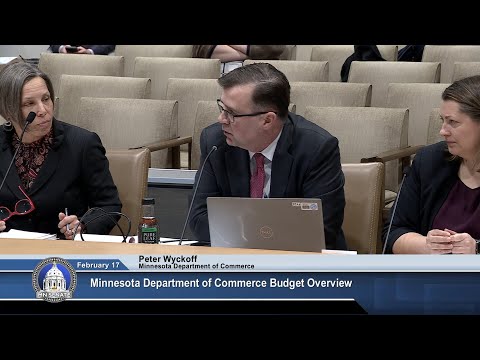
Commerce Commissioner Grace Arnold and Deputy Commissioner Pete Wyckoff presented the agency’s energy division budget and outlined both a governor’s request for state operating dollars and a broader portfolio of federal awards Commerce is implementing. “Currently under contract to commerce is a billion dollars in federal funding,” Wyckoff said. “As of the end of last week, all of that money is frozen.”
The department’s formal ask to the committee is $14,250,000 per year in state general fund support for the next biennium. Wyckoff described about $6,040,000 of that total as flexible, non‑ridered baseline funding the agency uses for core staff, analyses, and program administration, and he singled out $3.2 million in a budget rider for a pre‑weatherization program to ready homes for federal rebates.
Why it matters: Commerce officials said Minnesota has attracted large federal grants tied to the Inflation Reduction Act and the Bipartisan Infrastructure Law that supplement state investments and speed adoption of clean energy across urban, rural and tribal communities. If competitive or formula federal awards are not delivered, Wyckoff said, ratepayer bills and local economic outcomes could be affected because the state and…
Already have an account? Log in
Subscribe to keep reading
Unlock the rest of this article — and every article on Citizen Portal.
- Unlimited articles
- AI-powered breakdowns of topics, speakers, decisions, and budgets
- Instant alerts when your location has a new meeting
- Follow topics and more locations
- 1,000 AI Insights / month, plus AI Chat