Get Full Government Meeting Transcripts, Videos, & Alerts Forever!
Get email alerts on the Energy Budget And Federal Grants topic
No spam. Unsubscribe anytime.
Commerce warns federal funding freeze jeopardizes more than $1 billion in Minnesota clean‑energy work
Summary
The Minnesota Department of Commerce told the Senate Environment and Climate Committee Feb. 17 that over $1 billion in federal energy grants and contracts tied to state programs are frozen, and officials urged the Legislature to preserve state funding that helps secure federal dollars and run ongoing programs.
ST. PAUL — The Minnesota Department of Commerce told the Senate Environment and Climate Committee on Feb. 17 that more than $1 billion in federal clean‑energy grants and contracts now under the department are frozen and that the state’s ability to deliver programs ranging from solar for schools to home weatherization depends on continued federal funding and certain state appropriations.
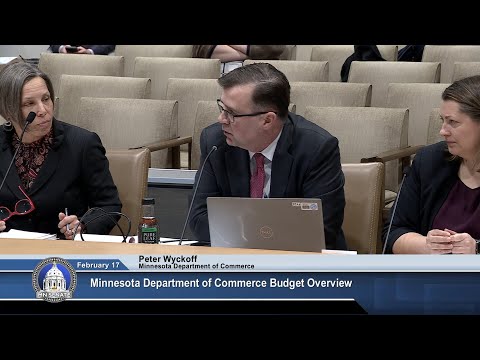
Commerce Commissioner Grace Arnold and Deputy Commissioner Pete Wyckoff presented the agency’s energy division budget and outlined both a governor’s request for state operating dollars and a broader portfolio of federal awards Commerce is implementing. “Currently under contract to commerce is a billion dollars in federal funding,” Wyckoff said. “As of the end of last week, all of that money is frozen.”
The department’s formal ask to the committee is $14,250,000 per year in state general fund support for the next biennium. Wyckoff described about $6,040,000 of that total as flexible, non‑ridered baseline funding the agency uses for core staff, analyses, and program administration, and he singled out $3.2 million in a budget rider for a pre‑weatherization program to ready homes for federal rebates.
Why it matters: Commerce officials said Minnesota has attracted large federal grants tied to the Inflation Reduction Act and the Bipartisan Infrastructure Law that supplement state investments and speed adoption of clean energy across urban, rural and tribal communities. If competitive or formula federal awards are not delivered, Wyckoff said, ratepayer bills and local economic outcomes could be affected because the state and utilities planned around those federal dollars.
Key programs and numbers - Solar for Schools: Commerce reported funding 141 school and higher‑education projects across the state under the 2023 expansion of the program. The department said projects are geographically distributed across urban and rural Minnesota. (Paul O’Shaughnessy, assistant commissioner)
- State Competitiveness Fund: Commerce is administering a roughly $100 million state pot to match federal grants. More than $80 million of that pot has been reserved; awards have ranged from about $29,000 to $10 million to date, Wyckoff said. The program has leveraged nearly $100 million in federal funding, the department reported.
- Electric resilience grants: The department said the program launched in September and that Commerce had received 40 applications from 29 applicants and would announce awards soon. The state program is designed to complement a federal program and allows funding for cybersecurity protections that the federal equivalent excludes.
- Weatherization and energy assistance: Wyckoff said Minnesota typically receives approximately $18 million in regular weatherization appropriations and recently had supplemented that with about $19.5 million from the Bipartisan Infrastructure Law; as of late last week that second pot was frozen. Assistant commissioner testimony estimated about 500,000 households might qualify for energy assistance and that Commerce weatherizes roughly 2,000–4,000 homes per year at an average cost of about $8,000 per home.
- Electric vehicle programs: Commerce reported all dollars for the initial EV rebate round were expended as of Dec. 30, 2024. The department said approximately 66,666 rebates were paid and that the combined rebate spending totaled about $15,000,000. Awards for electric school bus grants were described as imminent; officials said they expect to announce awards and could provide per‑bus figures after contracts are finalized.
Federal funding at risk and local impacts Wyckoff identified two large competitive awards in jeopardy if federal commitments do not proceed: a roughly $52 million competitive award for a magnet‑manufacturing pilot tied to a University of Minnesota spinout in Sartell, and an $812 million grant awarded to Great River Energy. “Every one of these grants that I’m showing here … is in danger or frozen as we speak,” Wyckoff said.
Committee members pressed Commerce for specifics about contingency planning. Wyckoff said the department and the Minnesota attorney general’s office are pursuing legal avenues and arguing that federal contracts should be honored; he described the freeze as unprecedented. Senators also raised concerns about program integrity and fraud; Commerce said it supports strong fraud prevention and that some federal funds have been paused while federal authorities review implementation.
Questions from senators and clarifications Senators repeatedly asked for more detail about the $6,040,000 baseline funding and how it has been used. Assistant Commissioner Paul O’Shaughnessy described that sum as core staff and administrative support across divisions — functions such as matching state funds to federal requirements, running the quadrennial energy report, fraud prevention for grant programs, and data and IT support for program management.
On decommissioning of wind turbines, Senator Gary Gruenhagen asked whether state law or a fund requires removal of concrete foundations left in fields after turbines are taken down. Commerce staff said decommissioning requirements are typically defined in the original project agreement and offered to follow up with more information for the senator’s constituent.
On the 2040 carbon‑free standard and cost modeling, Wyckoff said the department’s analyses did not assume frozen competitive grants; federal tax credits were assumed to continue. He described modeling that showed overall rate impacts could diverge depending on policy choices and future technology costs, and he cautioned that some clean‑firm technologies — long‑duration storage, new nuclear, carbon capture — are costly today and could raise system costs if required near 2040.
What the presentation did not change No formal committee votes or statutory changes were made at the hearing. The testimony served as an informational presentation and a request that the Senate consider the governor’s proposed operating adjustment and the Commerce budget as the Legislature considers its biennial appropriation decisions.
Speakers quoted or cited in this article include Grace Arnold, commissioner of the Minnesota Department of Commerce; Pete Wyckoff, deputy commissioner, Division of Energy Resources; Paul O’Shaughnessy and Melissa Polish, assistant commissioners; and multiple senators who questioned the department, including Senator Gary Gruenhagen, Senator John Matthews, Senator Nick Green, and Senator John Dibble.