Get Full Government Meeting Transcripts, Videos, & Alerts Forever!
Get email alerts on the Human Services Budget topic
No spam. Unsubscribe anytime.
Minnesota DHS outlines $1.57 billion in proposed cuts and reforms; senators raise concerns about county cost shifts and care impacts
Summary
Department of Human Services leaders presented the governor's 2025 budget proposal to the Minnesota Senate Human Services Committee on Feb. 17, outlining program-integrity changes, targeted savings and rate reforms that DHS said would reduce projected growth while directing new investments to some direct-care workers.
Department of Human Services leaders presented the governor's 2025 budget proposal to the Minnesota Senate Human Services Committee on Feb. 17, outlining program-integrity changes, targeted savings and rate reforms that Department staff said would reduce projected growth while directing new investments to some direct-care workers.
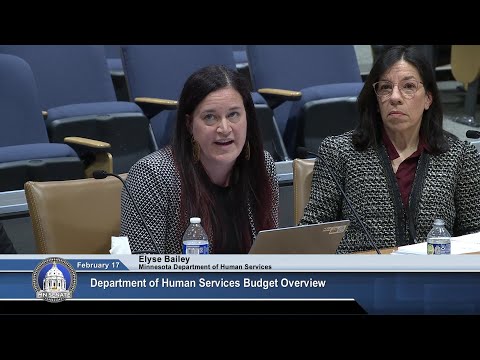
The committee heard the presentation from Shereen Gandhi, who is serving as temporary commissioner for the Department of Human Services, Elise Bailey, the department's budget director, and Natasha Mers, assistant commissioner for aging and disability services. Bailey summarized topline figures for the package: "the totals are about 372.4, million in savings in the first biennium, and 1,200,000,000.0 in the second, for a total of 1,570,000,000.00," and then described a long list of programmatic changes and cost-control proposals.
Why it matters: The package seeks to slow Medicaid and waiver spending growth while adding targeted supports for some direct-care workers. Committee members pressed DHS officials about the projected savings, the potential effects on nursing homes and small group-living providers, and a principal concern that much of the proposed reduction would be shifted to counties rather than federal or general-fund savings.
Key proposals presented
- Program integrity and early intensive behavioral interventions (EIDBI): Bailey said DHS would create provisional licensure for EIDBI providers, shorten provider revalidation cycles from five to three years, require background checks before provider enrollment, add maltreatment investigatory authority and clarify employer-employee definitions for EIDBI work. DHS said the change aims to protect people receiving services and improve oversight.
- Substance use disorder (SUD) billing and recovery residences: DHS proposed disaggregating current one-hour SUD billing codes into 15-minute unit codes to align with ASAM (American Society of Addiction Medicine) standards and to improve billing transparency. DHS also proposed certifying recovery residences (sober homes), maintaining a public certification list, investigating complaints and phasing out the freestanding room-and-board payment structure in favor of housing-support agreements for certified residences.
- Behavioral Health Fund changes: Bailey told the committee DHS would limit state-only behavioral-health fund eligibility to 60 days (down from 1 year), move eligibility processing from counties to DHS, and increase county shares of payments (noted in the presentation as from 22.9% to 50% except for carceral settings). DHS said the change aims to draw down federal Medicaid funds and encourage access to more comprehensive benefits.
- Disability waivers, CFSS/PCA wage and workforce investments: Assistant Commissioner Natasha Mers described investments tied to the transition from PCA to Community First Services and Supports (CFSS). She said the proposal includes wage increases phased in (40¢ an hour increases tied to training in Jan. 2026 and again in 2027), a higher enhanced rate (from 7.5% to 12.5%), retention stipends, orientation training funds, a matching system to connect workers and consumers, a study of health-care coverage options for the workforce and a retirement-trust proposal. Mers said these changes stem from collective bargaining and are intended to address workforce shortages.
- Controls on waiver and residential growth: DHS proposed tighter limits on rate exceptions in the disability waiver rate system, more monitoring of rate inputs, reduced absence/utilization assumptions (for residential and day services) to 3.9% (the presentation said this corresponds to 351 days/year), a study on overnight staffing (awake vs. asleep) and a proposed 5% county share for provider-controlled residential services.
- Nursing facility payment reforms and workforce floors: DHS told the committee the federal government will no longer accept the RUG (Resource Utilization Group) methodology and the state plans to transition to PDPM (Patient-Driven Payment Model). DHS also proposed several rate and payment reforms for nursing facilities, including temporary limits on inflationary increases (2% cap mentioned for operating rates) and funding directed by the Nursing Home Workforce Standards Board that would set wage floors (presentation listed ranges from roughly $19–$27 per hour with additional increases in 2027).
- Nonemergency medical transportation (NEMT) and administrative changes: Bailey described a single-administrator, per-member-per-month model to replace fee-for-service NEMT billing. DHS said it also proposes eliminating some underused grants (local planning grants) and one contract (Drug Effectiveness Review Project), and making technical accounting and statutory adjustments (including SMART access to electronic health records and conforming changes to prior statutory updates).
Fiscal framing and committee concerns
Bailey framed the package around three goals: strengthening program integrity, mitigating near-term fiscal cliffs, and curbing longer-term growth. Committee members repeatedly asked whether the package's savings are being taken disproportionately out of human services and whether savings are real versus shifted to counties. Multiple senators said they were concerned that the proposal shifts costs to counties and property taxpayers rather than producing net system-wide reductions.
Senator Gruenhagen and others warned small, rural nursing homes were financially fragile and asked whether the rate changes could cause closures. Bailey and Mers said it was difficult to predict individual facility outcomes and noted that some closures are driven by demand and occupancy trends as well as reimbursement. Senators also questioned how a 2% cap on inflationary adjustments for waiver and long-term care rates compares with the forecasted, automatic indexing DHS would otherwise apply.
Other committee questions and DHS responses
- Customized living for people under 55: DHS proposed limiting access to customized living services for new enrollees under age 55. Mers said existing residents would not be displaced, but the change would limit future placements and could encourage provider conversions to other waiver service models; the committee asked DHS to provide counts and demographic data for affected residents.
- Behavioral health eligibility and federal matching: Senators asked how many people currently served by the Behavioral Health Fund would have MA (Medical Assistance) eligibility; Bailey said eligibility rules are similar and that DHS would provide more detailed data.
- Federal Medicaid policy risks: Senators asked about potential federal changes (per-capita caps or FMAP reductions) and the department warned that changes to federal matching or a per-capita cap could have dramatic fiscal impacts, noting even small FMAP shifts produce large state-dollar changes.
What the committee asked DHS to provide
Committee members repeatedly asked for follow-up data and written clarifications, including: counts and demographics for people in customized living under age 55; detail on how DHS derived the biennial savings totals and which forecast base those reductions are measured against; the projected impact of the county-share proposals on local property taxes and provider payments; and federal-match sensitivity analyses.
No formal votes were taken during the Feb. 17 presentation. Chair Hoffman closed by scheduling continued hearings and hearings for public testimony later in the week, and the committee adjourned.
Ending note: DHS officials said they would work with MMB and committee staff to provide written follow-ups on forecast assumptions, county-share calculations, waiver exception counts and other data requested by senators.