Get Full Government Meeting Transcripts, Videos, & Alerts Forever!
Get email alerts on the Telecom Small Cells topic
No spam. Unsubscribe anytime.
San Mateo commission upholds wireless permit for 124 Warren Road, denies neighborhood appeals 5-0
Summary
The Sustainability and Infrastructure Commission on Feb. 12 denied appeals and upheld the conditional approval of a Crown Castle small‑cell wireless permit for a pole‑mounted installation in front of 124 Warren Road, concluding the application met the city’s 2021 wireless design standards and applicable federal rules.
The Sustainability and Infrastructure Commission on Feb. 12 denied appeals and upheld the conditional approval of a Crown Castle small‑cell wireless permit for a pole‑mounted installation in front of 124 Warren Road, concluding the application met the city’s 2021 wireless design standards and applicable federal rules.
The vote was 5-0 to deny the appeals and allow the permit to proceed, meaning the conditional approval will become an official wireless permit unless the applicant elects otherwise.
Staff told the commission the application complied with the 2021 design standards and with FCC regulations and that third‑party engineering review supported the director’s conditional approval. “Staff’s recommendation for this is to deny the appeals and uphold the conditional approval of the permit,” said JU, Public Works engineering manager.
Appellants, consolidated into a single appeal for the Warren Road site, argued the application failed to demonstrate that less‑obtrusive alternatives were infeasible and that the applicant had not shown clear, site‑specific coverage objectives. Ariel Strauss, counsel for appellant Alicia Woodifall Jones, told the commission the submission was “entirely boilerplate” and criticized reliance on generic citations to GO95 (PG&E) rules without site‑specific factual analysis.
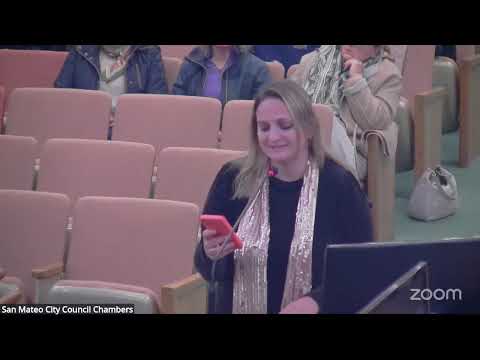
Nearby residents described the proposed antenna and its mounting arm as visually intrusive. Alicia Woodfall Jones, who identified her home as 50 feet from the pole, said the applicant’s photo simulations were “misleading, not proportionately accurate, and they diminish the visual impact of the tower.” Neighbors likewise urged the commission to require better justification of alternatives before allowing a facility sited so close to homes.
Crown Castle representatives and their engineering and legal consultants defended the application. Michael Cintron, Crown Castle permitting manager, asked the commission to focus on its limited legal role. “The sole issue before you is whether the appellants have met their burden of proof to establish that the permit approval should be reversed. They have not,” he said. Crown Castle’s engineer of record, Tyler Riesetter, cited PG&E clearance requirements and GEO‑95 as technical constraints that made a top‑mount installation infeasible at this pole, noting the pole lacked the minimum 6‑foot clearance required between energized wires and an antenna mount: “Per GEO 95 rule 38 in table 2, the required clearance … is 6 feet.”
Crown Castle counsel Suzanne Toler also cited the 2018 FCC small‑cell order and related case law, arguing cities have limited authority to deny small‑cell applications where denial would materially inhibit a provider’s ability to densify or introduce new services.
Commissioners questioned staff and Crown Castle about the alternative‑sites analysis, the city’s review process and whether median sites, new poles or different pole configurations had been adequately considered. Staff said they reviewed 19 potential alternatives within the required 500‑foot radius, and that many alternatives were ruled infeasible for reasons including PG&E transformer or clearance constraints, proximity to driveways and tree canopy that would materially reduce propagation. Staff and their RF consultant said that for the spectrum and equipment proposed, propagation for the proposed small cell drops substantially beyond roughly 200–300 feet, which limited feasible alternate locations.
After discussion, a commissioner moved to deny the consolidated appeals and uphold the director’s conditional approval. The roll call vote recorded the following yes votes: Commissioner Robbins; Commissioner Rowinski; Commissioner Kranz; Vice Chair Michael; and Chair Narita. The motion carried 5‑0. Staff told the commission the decision would be final at the commission level and, per the process described in the staff report, the wireless permit would be deemed approved following denial of appeals.
What the decision means now: with the appeals denied, the conditional approval for the Warren Road permit will convert to a permit that allows construction consistent with the approved plans and conditions. Several appellants and residents said they consider litigation or other legal remedies; Crown Castle said it will proceed with construction per the approved plans unless it makes a different business decision. The commission noted that future applications submitted after the new ordinance’s effective date follow a different review pathway and that applicants filing new applications after the ordinance took effect would be evaluated under the new rules.
Speakers at the hearing included city staff, Crown Castle representatives and multiple local residents who live within sight of the proposed pole. Commission legal counsel Stephanie Hall was available to answer legal questions in the hearing; staff clarified that the city’s public‑works attorney represents the department rather than advising the commission.
Votes at a glance: Deny consolidated appeals of wireless permit WC2024000243 (124 Warren Road); motion carried 5‑0; outcome: appeal denied, conditional approval upheld, permit to be deemed approved.
Ending: The commission did not revoke the director’s conditional approval. Staff said additional Crown Castle applications and related appeals remain pending and that the city may convene additional meetings to hear them. Appellants and residents signaled they would continue to press the issue with staff and through legal channels; Crown Castle said it aims to complete the program of small‑cell installations citywide consistent with the approvals it has obtained.