Get Full Government Meeting Transcripts, Videos, & Alerts Forever!
Get email alerts on the Executive Nominations topic
No spam. Unsubscribe anytime.
Senate Executive Nominations Committee advances a slate of gubernatorial nominees, holds three for later review
Summary
The Senate Executive Nominations Committee on Feb. 3 advanced a slate of nominations from Governor Wes Moore to various state boards and agencies and held three names for later consideration, voting by voice to move the remaining nominees forward.
The Senate Executive Nominations Committee on Feb. 3 advanced a slate of nominations from Governor Wes Moore to various state boards and agencies and held three names for later consideration, voting by voice to move the remaining nominees forward.
The committee heard introductions for more than a dozen nominees, each presented by a sponsoring senator, and conducted brief question-and-answer exchanges. Most nominees answered questions about their professional experience and how they would carry out duties if confirmed; a small number faced specific operational questions from committee members about agency processes or recent issues.
Marie Grant, nominated to lead the Maryland Insurance Administration, was introduced by her senator and received unanimous verbal support from committee members who praised her prior state service and outreach. “I’m just really honored, really humbled, to be nominated for this role by Governor Moore,” Grant said, adding she welcomed questions and collaboration as she transitions to the agency.
At length, the committee examined the nomination of Dr. Yolanda Ray Bethea to serve as director of the Division of Parole and Probation. Bethea described training and safety changes underway since she became acting director: “We have enhanced training from 18 hours to 40 hours, which includes recognizing the signs and symptoms of mental illness. It includes de‑escalation and defensive tactics,” she told the panel. She said the agency had upgraded safety equipment, engaged law‑enforcement partners for field contacts and expected pending legislation to provide additional equipment. Bethea also described ongoing engagement with the AFSCME union representing frontline staff, saying she met the union president on her second day and had continued negotiations and meetings since that time.
Morgan Miller, who has served as interim Maryland state librarian since June, explained the agency’s role in distributing state per‑capita aid to the 24 county public library systems, administering a state capital grant program and distributing federal competitive grants for projects ranging from digital‑equity work to early‑childhood literacy. “There’s nothing more local than your local public library,” Miller told senators, and she outlined how state support and targeted grants complement locally raised revenue.
The committee also questioned nominees to the Maryland State Board of Education about the ongoing rollout of the Blueprint for Maryland’s Future. Kenny Clash and Dr. Kimberly Ann Lewis—both nominees to the State Board—said they supported adjustments in the governor’s proposed legislation while stressing the need for the board to listen to local superintendents and to collaborate with the Accountability and Implementation Board. Clash said the board had formed a new committee focused on early childhood education; Lewis emphasized transparency and school‑level partnerships.
Xiomara (presented as Jayomara) Medina, another State Board nominee and a school counselor by training, was asked how the board can increase parental engagement and accessibility; she pointed to live‑streamed meetings, added public‑comment time and increased school visits as steps the board had taken.
Victoria Jackson Stanley, nominated to the State Board of Elections, was asked directly about the Jan. 6, 2021, attack on the U.S. Capitol. “I can confirm that I had nothing to do, no knowledge of, the January 6 debacle,” she said. Stanley discussed her lengthy local election experience, including service as a mayor and participation on local election boards.
Katrina J. Wiggins, nominated to the Property Tax Assessment Appeal Board, addressed downtime of the board’s website and said the site had been taken offline during a hosting move and was being migrated to the state’s DoIT infrastructure; she directed constituents to the State Department of Assessments and Taxation (SDAT) as the starting point for appeals while the PTAB site remained unavailable.
Daryl Armfield Kelly, a nominee to the Juvenile Services Education Board, discussed visiting facilities and exploring partnerships and workforce pathways—such as internships or “grow‑your‑own” programs—to help students transition to post‑placement opportunities.
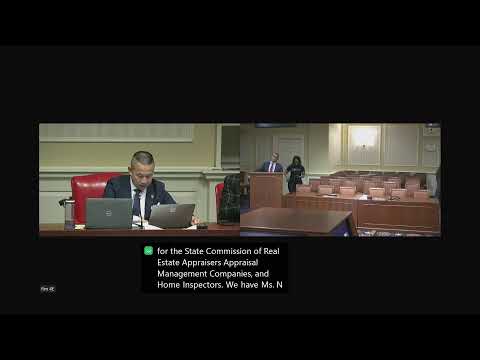
Other nominees presented during the hearing included Margaret Marie Chippendale to the Commission on Correctional Standards; Kenny Clash, Kimberly Ann Lewis and Xiomara Medina to the State Board of Education; Karen Denise Morgan to the State Ethics Commission; Rebecca Ballinger to the Maryland‑Ireland Trade Commission; Nneka (Nika) Nnamdi to the State Commission of Real Estate Appraisers, Appraisal Management Companies and Home Inspectors; and several others. Committee members generally offered brief endorsements or asked targeted questions about operations, outreach or recent controversies.
Votes at a glance
- Committee voice vote to advance nominees: the committee moved to advance all nominees presented during the hearing except three (referred to in the record as S1, S2 and S3), which the panel held for a later time. The motion to advance the remaining nominees was made from the vice chair’s seat and seconded; members responded in the affirmative by voice. No roll‑call tally was recorded in the hearing transcript.
What the committee did and did not decide
The committee did not confirm nominees on the Senate floor during the hearing; it voted only to advance or hold nominations for later consideration. The three identifiers S1, S2 and S3 were explicitly held for a future meeting and the committee asked that those individuals be asked to return. There was no recorded roll‑call vote or recorded dissent on the motion to advance the rest of the slate.
Why it matters
The nominations touch multiple areas of state policy — consumer protection, corrections and community supervision, public libraries, education oversight, elections and property assessment appeals — and the committee’s action sends most nominees to the next step of confirmation or to the Senate floor for final consideration. Several nominees committed to addressing operational problems at their agencies, including safety and training at parole and probation and website access for assessment appeals, while board nominees discussed how they would work with local officials on statewide implementation issues such as the Blueprint for Maryland’s Future.
Looking ahead
The committee indicated it expects to meet again the following Monday and signaled it would schedule the three held nominees to return for further consideration. The remainder of the slate will proceed toward final confirmation steps as scheduled by the Senate.