Get Full Government Meeting Transcripts, Videos, & Alerts Forever!
Get email alerts on the Appropriations Vote Session topic
No spam. Unsubscribe anytime.
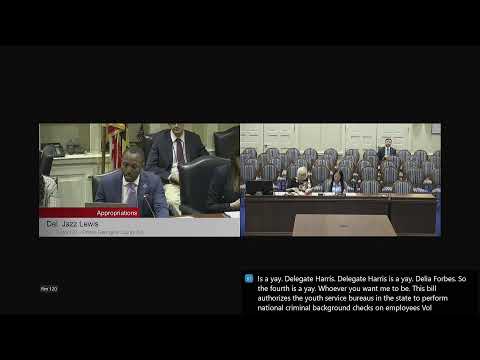
Appropriations Committee advances and adopts a slate of bills on safety, disability policy, housing, health and student supports
Summary
The Appropriations Committee held a voting session and approved a series of bills affecting public employee safety, disability employment policy, state land reuse, higher‑education student supports and health funding mechanisms.
The Appropriations Committee held a voting session and approved a series of bills affecting public employee safety, disability employment policy, state land reuse, higher‑education student supports and health funding mechanisms.
House Bill 176, introduced by Delegate Lewis, was approved as amended. The bill establishes a Public Employee Safety and Health Unit in the Division of Labor and Industry within the Maryland Department of Labor and brings certain public bodies within the scope of Maryland Occupational Safety and Health (MOSH) protections. Amendments adopted during the session removed additional penalties for public bodies and elected officials, granted statutory authority for the Department of Public Safety to authorize body‑worn cameras for parole and probation agents, and included an orally offered, minority‑party friendly amendment clarifying that the statutory camera language does not mandate camera use in local detention facilities. The committee adopted the amendments and voted to move the bill.
House Bill 502, presented by Delegate Shetty, was approved. The departmental bill establishes the Office of Disability Employment Advancement and Policy in the Maryland Department of Disabilities to implement the State's disability employment initiatives, including the Maryland as a Bridal employer initiative (as described in the bill text). Committee members considered the measure and voted to move it forward; there were no floor amendments to the bill during the session.
House Bill 599, introduced by Delegate Solomon, creates a binding arbitration mechanism for Baltimore–Washington International (BWI) firefighters. The bill as amended clarifies that an arbitrator's decision is subject to limitations of the State budget and adds provisions to amend the State Constitution so that future budget bills include appropriations necessary to implement terms agreed in memoranda of understanding, making implementation contingent on passage of a constitutional amendment. Two amendments were adopted before the committee approved the bill.
House Bill 980, presented by Delegate Smith, expands eligibility for the Conroy Memorial Scholarship Program to include certain Maryland residents who were dependents or surviving spouses of U.S. Armed Forces members and who are eligible for the federal Chapter 35 Survivors' Dependents Educational Assistance benefit. The committee adopted two amendments, including a technical clarification that aligns Chapter 35 eligibility with the scholarship and a delayed effective date of July 1, 2026, to avoid fiscal year 2026 impacts; the bill passed the committee.
House Bill 1061, presented by Delegate Watson, requires the Maryland Department of Planning, in consultation with the Department of Housing and Community Development, to assess state‑owned property for suitability for redevelopment, affordable housing and mixed‑use development and directs DHCD to develop proposals to donate or sell excess state property for such redevelopment. The committee adopted amendments that removed a requirement to assess state property for solar energy suitability and clarified reporting procedures; the amended bill passed.
House Bill 1090, presented by Delegate Smith, requires the Maryland Higher Education Commission to add a question to the Maryland College Aid Processing System (MD CAPS) asking whether, in the previous six months, an applicant missed a meal because they could not afford it. The bill's amendments removed a requirement that the Department of Human Services provide food supplemental benefits and narrowed the measure to data collection for future intervention planning; committee members discussed the measure briefly and approved it.
House Bill 1104, presented by Delegate Shetty, establishes a Population Health Improvement Fund to support statewide population health targets under the AHEAD model and successor models. The Health Services Cost Review Commission may assess a uniform, broad‑based hospital assessment credited to the fund; the bill requires annual MDH progress reports on fund sources and included a sunset date of Jan. 1, 2032 in the adopted amendment. Committee members noted the Health and Government Operations (HGO) committee's prior recorded vote (reported at the hearing as 19‑4 or 5 against in HGO). The committee approved the bill as amended.
House Bill 1352, described to the committee during the session, prohibits institutions of higher education from denying access to facilities or services to a student based on a sickle cell disease diagnosis, requires reasonable accommodations, and directs the Department of Health to work with specified organizations to develop education and awareness campaigns for campuses; the committee voted to move the bill favorably.
A separate bill authorizing youth service bureaus to perform national criminal background checks using the CJIS central repository of the Department of Public Safety and Correctional Services was also approved. Committee members noted the background checks are applicant‑funded and that the statutory authority authorizes restoration of access that had been lost after a federal change two years earlier.
The committee recorded a small number of negative votes on several measures but adopted the amendments and moved the bills as described. Toward the end of the session the chair said more votes were likely on Thursday.