Get Full Government Meeting Transcripts, Videos, & Alerts Forever!
Get email alerts on the Invasive Species Removal topic
No spam. Unsubscribe anytime.
Keep Oconee County Beautiful describes multi-year invasive removal effort at Heritage Park
Summary
Keep Oconee County Beautiful briefed the Oconee County Board of Commissioners on a six-year volunteer program to remove invasive plants, focusing on autumn olive at Heritage Park and coordinated with local partners and Parks and Recreation.
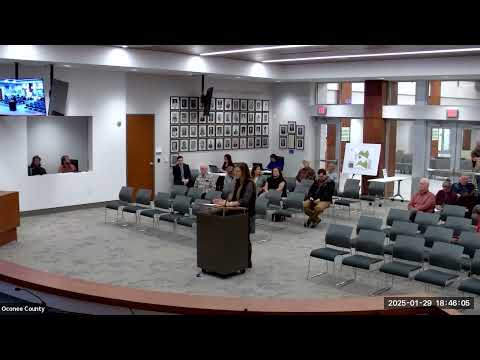
Cindy Pritchard, executive director of Keep Oconee County Beautiful, told the Oconee County Board of Commissioners that a volunteer-driven invasive removal program at Heritage Park has continued for six years and remains active.
Pritchard said the project began after a tree inventory and a volunteer report of a heavy infestation of an invasive plant identified as autumn olive. She said the program is run in partnership with Athens Land Trust, Oconee Parks and Recreation, the Kelmack Saddle Club, the Parks Foundation and student volunteers.
The program uses a combination of cutting and targeted herbicide treatment timed to seasonal plant cycles, Pritchard said. "We're using bigger sprayers that we can do foliar spray. You can only do that while the leaves are on, and you have to start in August," she said. She described a follow-up technique called a basal or "bridal bark" treatment for large stumps, applied with backpack sprayers around the trunk to prevent regrowth.
Pritchard said volunteers meet every two weeks from September through February for cut-and-treat work; she added that earlier methods would likely have completed the initial infestation faster if they had known them at the outset. She estimated the infestation covered "upwards of a hundred acres" in parts of the park and said birds spreading seeds contributed to the plant's spread.
She described ecological impacts the group is trying to reverse: "As many of our invasives are not native ... there's not a native caterpillar to them. And so when birds nest there, there's no caterpillars for them to feed the babies," she said, adding that volunteers have noticed birds returning to previously overgrown areas after treatment.
Pritchard encouraged residents to participate: the group has two more workdays in February and plans a March review of treated areas to identify targets for next season. She also noted the project has generated volunteer awards and local recognition; volunteers and partners have helped free Parks and Recreation staff for other duties.
Pritchard cautioned that the work requires trained volunteers and the use of chemicals for targeted treatments: "Chemicals were made for these specific purposes... we train all of our volunteers in how to do it, and it is very effective," she said.
The presentation included recommendations to expand public education during Invasive Species Awareness Week in February and to encourage homeowners to remove invasive plants from private yards to limit seed spread into parks.
The commission thanked Pritchard and invited residents to volunteer or ask questions after the presentation.