Get Full Government Meeting Transcripts, Videos, & Alerts Forever!
Get email alerts on the Education Funding topic
No spam. Unsubscribe anytime.
Wicomico County executive outlines four budget options as schools seek millions in new funding
Summary
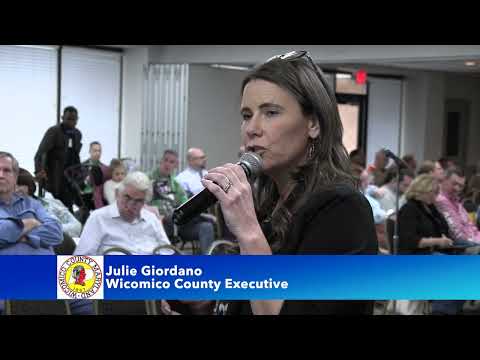
County Executive Julie Giordano told a packed public hearing that a local revenue cap limits how much property-tax revenue the county can raise and presented four options for funding the Wicomico County Public SchoolsFY26 request, while school leaders and dozens of residents urged the county to increase local education funding.
County Executive Julie Giordano on Monday described a narrowing set of choices for the county—s fiscal-year 2026 operating budget, telling a large public hearing that a local revenue cap will sharply restrict property-tax revenue and that the Board of Education is asking for about $4 million more than the county currently plans to raise from property taxes.
Giordano said the county—s largest revenue source has shifted from local property tax to income tax and that, under the revenue-cap rules, the county can increase property-tax revenue by roughly $1.6 million next year. "We have a revenue cap," Giordano said during the presentation. "What the revenue cap is is that we can only take in a certain amount of revenue." She added that the state has shifted some costs to counties, notably about $3 million in teacher pension costs that the county did not previously pay.
The county executive laid out four options for responding to the school system—s FY26 request: 1) fully fund the Board of Education—s ask while cutting other departments; 2) seek an explicit property-tax line item or override to "break" the revenue cap for education so other departments remain funded; 3) spread the limited increase across all departments (the approach used the last two years); or 4) fund only the state-mandated maintenance-of-effort (MOE) level and leave further increases to the council.
Why it matters: Wicomico County Public Schools (WCPS) leaders warned that local funding has not kept pace with enrollment growth and inflation. Micah Stauffer, superintendent of Wicomico County Public Schools, thanked county leadership for two years of above-MOE funding and said the district needs sustained increases to reduce overcrowding, expand extracurriculars and meet growing student needs. "Without adequate local funding, our schools cannot provide the best opportunities for students academically or through extracurriculars," Stauffer said.
More details and public comment:Giordano presented unaudited FY24 figures showing income-tax receipts of about $77 million and that the county expects to collect roughly $1.6 million in additional property-tax revenue under the 2% allowable increase. She said the county—s proposed FY26 education budget line is approximately $58.5 million (this number, she said, includes some Warwick-related school costs but excludes a separate $12.9 million debt-service line tied to school construction). Giordano used a per-pupil slide that showed the state contribution at $15,186 per pupil and the county contribution at $3,652, for a combined $18,839 per pupil in the county—s chart.
Board of Education leaders and many residents urged more funding. Jean Malone, chair of the Wicomico County Board of Education, said the district is the fastest-growing in Maryland and asked for a budget that addressed inflation and growth: "Our request to the county includes 3% above MOE amount to address the 3% inflation ... In addition, we request another 2% as an investment in our schools," Malone said. Brian Reager, the school system—s chief finance and operations officer, warned that if the county only provides MOE for FY26, Wicomico would fall to last in Maryland in local per-pupil operating funding.
Public-safety and other trade-offs: Jamie Dyke, Wicomico County state—s attorney, spoke after education advocates and urged the county not to underfund criminal-justice operations amid a recent rise in violent crime, saying the county has a disproportionate volume of felony filings and trials compared with neighboring counties. "We cannot do that with increased mandates without adequate resources and funding," Dyke said.
Many residents, teachers and student leaders said the county should choose either option 1 or option 2. Public commenters described overcrowded classrooms, teachers paying for supplies, and students lacking access to extracurriculars and stable support staff. Teacher-of-the-year Debbie Reynolds said county per-pupil funding has fallen in real terms since 2010 and called for a long-term funding plan. A number of speakers favored a blue-ribbon panel to examine the revenue-cap policy and the county—s long-term options.
Clarifying numbers from the hearing: Giordano told attendees that each penny in the property-tax rate generates roughly $800,000 for the county; she said the school system—s $4 million ask would amount to about a 5-cent increase in the tax rate and estimated the monthly effect at roughly $5—$25 depending on assessed value. She also said the state will reimburse only principal, not interest, on an anticipated short-term borrowing to forward-fund Fruitland Primary construction if the county covers state-share costs while the state lacks cash.
What—s next: Giordano said the county—s proposed budget and presentation materials will be posted on the county finance website and that the county council will receive the executive—s proposed budget for consideration. No formal vote or budget adoption occurred at the hearing; council action will follow the executive—s filing and the council—s review process.
Ending note: Speakers at the public hearing reflected broad agreement that education funding matters to the county—s future, but they were sharply divided over the revenue-cap question and how to balance school funding with other mandated services. Giordano told the audience she would weigh those trade-offs and work through the budget process with the council, noting the competing pressures of mandates, public safety and maintaining the county—s fund balance.