Get Full Government Meeting Transcripts, Videos, & Alerts Forever!
Get email alerts on the Decd Bills Film Tax topic
No spam. Unsubscribe anytime.
DECD outlines technical changes to economic programs; film tax credit draws industry pushback
Summary
DECD told the Commerce Committee that House Bills 7165 and 7166 contain technical clarifications to tax credits, workforce and property rules; film‑production stakeholders asked for credit stability and fuller consultation.
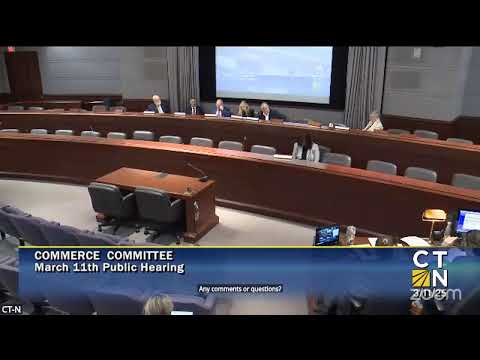
Deputy Commissioner Matt Pugliese of the Department of Economic and Community Development (DECD) testified to the Commerce Committee about two agency packages, House Bill 7165 and House Bill 7166, describing multiple technical amendments and clarifications.
“Section 1 of 71 65 allows DCD to create a sales program to sell Connecticut branded merchandise as well as advertising space on c2visit.com,” Pugliese told the committee. He summarized other provisions that would clarify prevailing‑wage applicability for brownfield remediation work, conform an intellectual and developmental disability workforce grant program to federal competitive integrated employment standards, clarify that post‑award tax credits are not “state assistance” for nonrelocation rules, and restore statutory language permitting DECD to provide assistance to Advance CT for business recruitment.
Pugliese said DOL and other agencies had reviewed the draft language and that DECD expected to file minor clarifying amendments with the committee. He also described the department’s strategic supply‑chain program and said applications were under review; he said previously authorized funds were being repurposed for the program.
Several witnesses addressed the film production tax credit and broader incentives. Production company executives said the industry operates like manufacturing and stressed the number of blue‑collar jobs tied to productions. Jonathan Black of Cheriton Productions described his firm’s move from Los Angeles, saying his company employed roughly 350 people across two projects and expected to hire up to 450 in 2025. “We are a production services company. We moved our company from Los Angeles to here,” Black said, adding that productions hire hotels, catering, local construction and dozens of trades.
Industry witnesses warned that proposed reductions in the production tax credit would reduce the state’s competitiveness and make projects leave for neighboring states. Black and other producers urged fuller consultation before adopting changes and asked for greater predictability in the credit’s long‑term availability.
Brie Wolf, DECD’s director of government affairs, told the committee that the state auditor’s review that prompted statutory clarifications was a compliance audit, not an economic impact study. “The state auditor's report is simply about DCD's compliance with, laws and, with state statute and regulation. It did not contemplate such an economic analysis,” Wolf said. DECD staff said they were willing to work with the committee and the Office of Policy and Management on any additional economic analysis requested by legislators.
Committee members asked DECD for follow‑up materials on the department’s R&D credit language, the film credit transfer market and the supply‑chain program timeline. No final committee action was recorded at the hearing; members asked DECD to submit amended language and supplemental analyses before any floor referral.
Ending note: DECD agreed to return with amended bill language on some sections and with additional data on film‑credit administration and the strategic supply‑chain competitive process.