Get Full Government Meeting Transcripts, Videos, & Alerts Forever!
Get email alerts on the State Budget Forecast topic
No spam. Unsubscribe anytime.
Minnesota forecast shows small FY2026-27 surplus but larger planning-year shortfall amid federal uncertainty
Summary
Commissioner Erin Campbell of Minnesota Management and Budget told the Senate Finance Committee on Feb. 10 that the February 2025 forecast projects a $456 million balance for FY 2026‑27, down about $160 million from November, and a near $6 billion deficit for FY 2028‑29 driven by inflation and rising health and education costs.
Commissioner Erin Campbell of Minnesota Management and Budget told the Senate Finance Committee on Feb. 10 that the February 2025 budget and economic forecast shows a $456 million projected balance for the FY 2026‑27 biennium, down about $160 million from the November estimate.
The presentation emphasized that while revenues are modestly higher in some categories, spending growth—largely in education and health and human services—has increased the projected planning‑year shortfall. "We now forecast a positive balance of $456,000,000 for FY 26‑27," Commissioner Campbell said, adding that the planning years now show a projected deficit just under $6 billion for FY 2028‑29.
The nut graf: The forecast offers the four‑year outlook lawmakers use to write the biennial budget and highlights two central pressures: higher inflation that raises both revenues and costs, and uncertainty about federal policy, especially possible reductions in Medicaid funding that could materially worsen the state's position.
State economist Dr. Anthony Becker said national factors pushed the outlook in February. He described higher forecasts for 2025 inflation and a tighter interest‑rate path from the Federal Reserve, saying the consultant SPGMI supplied assumptions that include tariffs and slower net international migration. "SPGMI now predicts only one rate cut in 2025 with further rate cuts paused until mid‑2026," Becker said, noting those assumptions weigh on long‑term growth and borrowing costs.
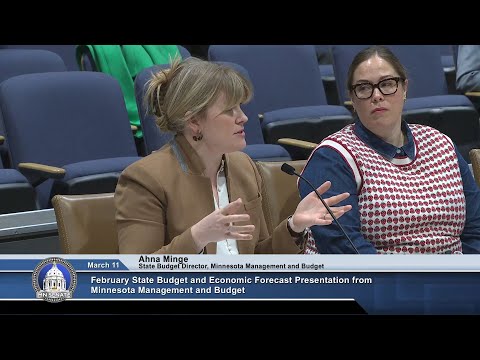
State Budget Director Anna Menge reviewed how state spending changed since November. "Spending is projected to be higher than our November estimates by $790,000,000 in the first biennium and $960,000,000 in the second," she said. Education and health and human services accounted for most of the increases: education rose by about $198 million in FY 2026‑27 and $339 million in FY 2028‑29, while HHS rose by roughly $338 million and $359 million, respectively. Long‑term care rate and caseload growth accounted for a sizable share of the HHS increase.
Menge highlighted several specific drivers and clarifications included in the forecast: an estimate of discretionary inflation of about $1.1 billion for FY 2026‑27 (up $219 million since November) meant to show the cost of maintaining current services if the Legislature chooses to fund inflation adjustments; higher utilization and costs for weight‑loss drugs in managed care, estimated to raise medical assistance spending by $80–$90 million per biennium; and a smaller assumed 2025 bonding bill ($700 million) compared with the $790 million assumed in the November forecast.
MMB officials also flagged a separate budget adjustment: a $113 million repayment to the federal government tied to past billing of tribal residential behavioral health services. Anna Menge said the forecast treats that repayment as a true‑up of past funding sources rather than a change in covered services.
Officials stressed Minnesota's federal reliance: the forecast projects about $45 billion in federal funds in FY 2026‑27, with more than half tied to medical assistance. "Our forecast assumes no reduction in federal Medicaid funding because any outcome of congressional action is unknown at this time," Menge said, while warning that proposals discussed in Congress — including limits to the enhanced match for expansion populations — could quickly and substantially raise state costs. The presentation noted eliminating the enhanced match for the expansion group could amount to roughly a $2.4 billion effect on the state budget in 2026‑27 under one scenario described in the briefing materials.
Committee members pressed officials on presentation format and key risks. Chair Sen. Marty asked for a version of the slide showing the four‑year horizon without discretionary inflation; Commissioner Campbell agreed, "We can mock that up." Senators also questioned the size and timing of projected increases, the methodology for annualized growth rates, the expected effects of tariffs and trade policy, and whether recent federal actions could trigger materially larger shortfalls.
During Q&A, MMB said the forecast incorporated data through the SPGMI baseline provided Feb. 10 and that staff will publish an updated revenue and economic outlook on the monthly and quarterly schedule, with an April 10 update noted in the presentation. Becker added that alternative scenarios from the consultant would be available later in the week and could revise downside risk estimates.
The presentation includes several items lawmakers will weigh as they draft the FY 2026‑27 budget: whether to appropriate discretionary inflation adjustments, how to respond to rising HHS costs (including long‑term care and new pharmaceutical utilization), how much to assume for bonding, and contingency planning for potential federal funding changes. MMB emphasized Minnesota's fiscal reserves and long‑range forecasting as tools to manage uncertainty but cautioned that large federal cuts would force difficult tradeoffs.
The department closed the briefing by offering to answer further questions and to provide supplemental slides and data requested by the committee. The committee adjourned after a broad-ranging discussion about the forecast and the budget choices it frames.