Get Full Government Meeting Transcripts, Videos, & Alerts Forever!
Get email alerts on the Reinsurance Extension topic
No spam. Unsubscribe anytime.
Senate panel hears extensive testimony for reinsurance extension, funding options
Summary
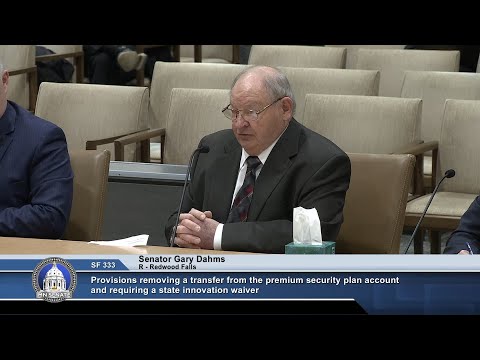
Senate File 3 33 would extend Minnesota's individual-market reinsurance program and requests $512 million to the premium security account for plan years 2026–27, sponsors said.
Senator Dave Dames, sponsor of Senate File 3 33, told the committee that the bill would secure funding and extend Minnesota's reinsurance program for the remaining two years of a federal Section 1332 waiver period, and he said the bill requests $512 million for the premium security account covering plan years 2026 and 2027. "Section 4 is where it's requesting funding and it's requesting 512,000,000, to be put into the premium security account," Dames said.
Witnesses representing insurers, employers and business groups described the program's effect in lowering individual-market premiums and stabilizing enrollment. Dan Andreessen of the Minnesota Council of Health Plans testified that the program "has been a resounding success," describing the state's attachment-point model that pays 80% of claims between $50,000 and $250,000 and noting reinsurance is fully spent on medical claims, not administrative costs. Bentley Graves of the Minnesota Chamber of Commerce and Anne New Brindley of the Minnesota Business Partnership said reinsurance reduced premiums and prevented market collapse after steep increases in 2016–17.
Multiple witnesses and the sponsor highlighted the federal pass-through and waiver mechanics: when Minnesota renewed its waiver application it gained a second federal pass-through portion (about $30 million in recent years), and the program leverages federal funding expected to be about $130 million per year in current projections. Senator Dames said that if the legislature left the premium security account fund balance in place, the net new general fund ask could be lower, but the bill requests the $512 million total.
Opponents urged caution and questioned whether reinsurance merely shifts costs to taxpayers without addressing underlying health-care price growth. Leota Goodney, a retired CPA, said Minnesota had spent "over a billion dollars of taxpayer dollars" on reinsurance since 2018 and urged exploring alternatives. Matt Flanders of Citizens Council for Health Freedom called the program a "redistribution system" that perpetuates taxpayer funding and raised privacy concerns about claims data shared under reinsurance processes.
Committee members probed risks tied to federal decisions: some members recalled a prior period when federal funding was partially withheld under a prior administration and asked how the state would respond if federal pass-through funding were reduced. Senator Dames and other supporters said the state has multiple funding levers used previously (general fund, Health Care Access Fund, premium security account balances and federal funds) and urged continuation to avoid premium spikes.
The committee laid Senate File 3 33 over for further consideration and requested additional work on funding options; no final passage vote was taken.