Get Full Government Meeting Transcripts, Videos, & Alerts Forever!
Get email alerts on the School Funding Seasonal Properties topic
No spam. Unsubscribe anytime.
Senate file 11‑97 advances to taxes committee after testimony on cabin‑wealth school aid
Summary
Senate file 11‑97, a bill to create a seasonal and recreational tax‑based replacement aid to reduce local tax effort on voter‑approved school levies, was moved to the Senate Taxes Committee after testimony from rural school officials and educators about funding inequities tied to seasonal properties.
Senate file 11‑97, which would create a seasonal and recreational tax‑based replacement aid to reduce the local tax effort required for voter‑approved school operating levies, was moved from the Senate Education Finance Committee to the Committee on Taxes after public testimony and committee discussion.
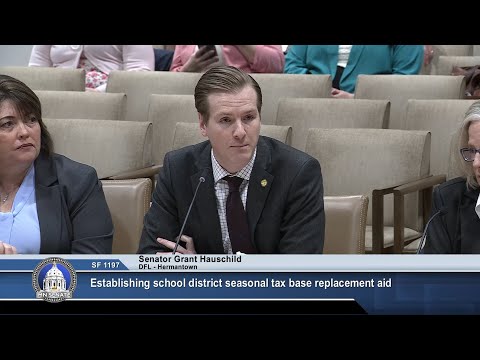
The bill’s chief author, Senator Hauschild, told the committee the aid is intended to acknowledge that seasonal and recreational property wealth (cabins, second homes) increases a district’s market value but does not currently reduce the local tax effort for voter‑approved operating levies. "The bill does not change how cabins are taxed," Hauschild said. "This bill also doesn't change how much...seasonal recreational property will be taxed. Instead, my bill is aimed at having the state acknowledge that this property tax wealth is needed to make things fairer for the students in Central and Northern Minnesota."
The nut graf: supporters said SF 11‑97 targets an imbalance in Minnesota school funding by shifting some state general fund dollars to districts with high shares of seasonal recreational property, reducing the effective local tax rate that voters would face when asked to approve operating referendums.
Testimony came from educators and local officials describing failed referendums and program cuts. Carol Kopp, a 30‑year English teacher from Grand Rapids, said her district cut the equivalent of a small school district over five years and that voters faced much larger per‑property impacts than metro districts when attempting an operating referendum. "Every single school district without a referendum is more than 30 miles from where I'm sitting right now," Kopp said. She told the committee that SF 11‑97 would reduce the tax burden on her citizens by about 20 percent and increase the likelihood of future referendum passage.
Ely superintendent Anne "Annie Oakley" Elke said Ely’s operating levy yields $327.96 per pupil but the district does not receive all of those dollars under current funding structures. "If Ely received the state average, that would mean an additional $567,000 for our school," Elke said, describing looming budget reductions totaling about $460,000 that could affect teachers and programs.
Lake Superior School District superintendent Gina Clive said districts with large seasonal property markets consistently struggle to pass local levies; she estimated the bill could reduce the voter‑approved operating referendum tax rate by about 31.4 percent for a sample ask and called the proposal a "game changer" for rural districts.
A department witness described how seasonal recreational properties are included in the local net tax capacity base (NTC) but excluded from the referendum market value tax base, and noted the statewide amount raised from a state general levy on seasonal recreational properties totaled roughly $41.7 million in a prior year; those receipts go to the state general fund.
Committee action: Chair Kunish moved SF 11‑97 "recommended to pass, referred to the Committee on Taxes." The committee approved the motion by voice vote; no numeric tally was recorded in the transcript. The chair said the bill would be laid over for possible inclusion in a future omnibus bill.
Ending: Committee members signaled bipartisan concern about rural‑metro funding disparities and several asked staff and the author to provide additional fiscal context as the bill proceeds to the Taxes Committee.