Get Full Government Meeting Transcripts, Videos, & Alerts Forever!
Get email alerts on the Film Industry topic
No spam. Unsubscribe anytime.
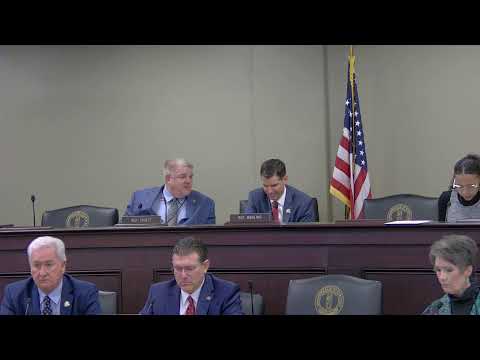
Kentucky House committee approves bill to establish state film office and leadership council
Summary
The House standing committee on economic development voted to pass Senate Bill 1 with a House committee substitute to create a Kentucky Film Office, a film leadership council and an executive director post, including a $225,000 salary cap and a limited initial funding source.
State Sen. Telewheeler, joined by other backers, told the Kentucky House standing committee on economic development on Wednesday that Senate Bill 1 aims to create a Kentucky Film Office and industry leadership council to promote film production in the state.
Telewheeler said the bill will provide “the infrastructure necessary to attract these types of feature films to the Commonwealth of Kentucky,” and described film tourism and production as potential economic drivers for rural and urban areas alike. He said Kentucky already has generous film tax incentives but lacks dedicated marketing and staffing to attract larger projects.
The bill creates an executive director role for the new film office and a leadership council made up of industry and cabinet representatives. The House committee substitute adds a salary cap for the office’s executive director at $225,000 and corrects a small date error. Committee discussion noted the bill would allow the office to build an online location database similar to Georgia’s film office website.
Andrew McNeil, president of the Kentucky Forum on Rights, Economics, and Education, urged caution. He criticized refundable check-style subsidies and said recent productions had received larger public subsidies than box-office receipts for some films. “These aren’t incentives. These are subsidies,” McNeil said, urging delay for further review and transparency about financing.
Bill supporters responded that the incentive program is monitored and requires productions to demonstrate local spending and payroll reporting before refunds are issued. Sponsors also said local hotels and vendors have already seen direct benefits during shoots.
Committee members asked about comparisons with Georgia’s program, the meaning and handling of an “obscenity” exclusion, local economic impact estimates and how the film office would be funded. Backers cited a University of Louisville study that estimated the state’s motion picture and recording industry generated about $200 million in revenue in 2022, with roughly $128 million flowing to other local businesses and $27 million paid in federal, state and local taxes. The substitute authorizes taking up to $500,000 from the transient room tax to seed the office’s work.
After questions and public comment, the committee adopted House Committee Substitute 1 and passed the bill. The committee’s action on the bill was recorded as “passes with the expression of opinion that the same should pass.”
The committee record shows a mix of support and requests for follow-up: several members said they would vote yes while asking for later conversations about local hiring priorities and how the office will be run; at least one member asked to “pass” to follow up with sponsors before a final vote. The bill passed out of committee with the substitute in place.
If enacted, SB 1 establishes the Kentucky Film Office, a leadership council, and an executive director post; provides initial funding authority from transient room tax revenues; and includes a salary cap for the executive director. The bill as amended now moves on in the legislative process.
Details offered during the hearing and questions from members indicate committee members want future reports and monitoring of how incentives are used, how local labor and vendors are prioritized, and stronger transparency about production financing.
Votes at a glance: the committee passed Senate Bill 1 as amended by House Committee Substitute 1; the committee chair announced that the bill passed with the expression of opinion that it should pass. The committee transcript records multiple named “yes/aye” votes; the committee substitute was adopted before final passage.