Get Full Government Meeting Transcripts, Videos, & Alerts Forever!
Get email alerts on the Small Business Development topic
No spam. Unsubscribe anytime.
Georgia dealers urge House to pass Senate Bill 81 to update franchise law, citing data security and market clarity
Summary
Ben Jordan, a representative of the Georgia Automobile Dealers Association, told the House Committee on Regulated Industries that Senate Bill 81 would update Georgia's dealer franchise laws to strengthen dealer control over customer data, require payment for dealer work on certain over-the-air updates, increase allocation transparency and define permissible activity at nonlicensed vehicle display locations.
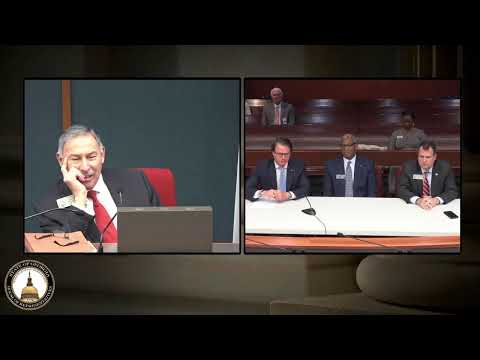
Ben Jordan, a representative of the Georgia Automobile Dealers Association, told the House Committee on Regulated Industries on the morning the association supports Senate Bill 81, legislation he said would update Georgia's dealer franchise laws to address data control, over-the-air updates, allocation transparency and activity at nonlicensed sales locations.
If passed, Jordan said the bill “would give dealers greater ability to control and protect the customer data that's on their dealer management systems,” and would allow dealers to back up that data and share it only via approved, secure integrations. He told the committee the changes are intended to help dealers restore operations quickly after incidents such as a June cyberattack that, he said, forced many dealers to hand-write repair orders and contributed to roughly $1 billion in lost revenue nationwide.
The bill, Senate Bill 81, passed the Georgia Senate overwhelmingly and is being carried in the House by Chairman Alan Powell; Jordan said it has passed the House Committee on Regulated Industries and is under consideration by the House Rules Committee. “So if and when this bill does get out of Rules and onto the House floor, we'd certainly appreciate favorable consideration,” Jordan said.
Why it matters: franchise new-car dealers are locally owned employers and service providers, the witnesses told lawmakers. Jordan said there are just under 500 franchise new-car dealers in Georgia, that a typical franchise dealer employs about 71 people and that dealers provide new- and used-vehicle sales, safety-critical repairs, warranty and recall work, body-shop services and title and financing processing.
Senator Emmanuel Jones, who also identified himself as a longtime dealer with Legacy Ford, described past vendor relationships and why he supports the legislation. Jones recalled when manufacturers shifted dealer-management systems between vendors and said the changes limited dealers' options and tied many to long leases and services. “That data breach that occurred back in June of last year … had dealers like mine shut down for well over two weeks,” Jones said, adding that the bill would permit on-site storage or alternate vendors that could increase competition.
Dealers on the panel described additional market challenges and local investments. Jason Denson, owner of Ford of Dalton, described hiring growth at his dealership and investments in staff training and electric-vehicle charging. Dealers also told the committee they still rely heavily on service-department revenue, that technicians are in short supply, and that uncertainty about battery condition complicates used-EV valuations.
The bill would also: (1) update statutory legislative findings; (2) set rules for data protections and backups on dealer management systems; (3) require payment to dealers who assist with over-the-air updates when the work relates to warranty repairs; (4) require manufacturers to provide allocation information on request to dealers to increase transparency; and (5) define activities that constitute conducting dealer business at nonlicensed locations, allowing display without a license but requiring licensure for price negotiation, reservations, deposits, trade-ins or financing discussions. Jordan told the committee the provision on nonlicensed locations is meant to clarify activity that currently occurs at some showrooms and galleries.
No formal action or vote on SB 81 occurred at the hearing recorded in the transcript; the session was a panel presentation and question period. Witnesses said they had negotiated aspects of the bill with manufacturer partners before filing and that the current House version reflects that feedback.
Looking ahead, dealers said the bill's data provisions would reduce vendor lock-in and help dealers recover from future cyber incidents; committee members pressed on service-department economics, EV-charging investments and the practical effects of allocation transparency. Jordan and panel members offered to provide additional detail to the committee as the bill moves forward.
The committee concluded the presentation and moved on without a formal vote on the measure at that time.