Get Full Government Meeting Transcripts, Videos, & Alerts Forever!
Get email alerts on the Health Safety topic
No spam. Unsubscribe anytime.
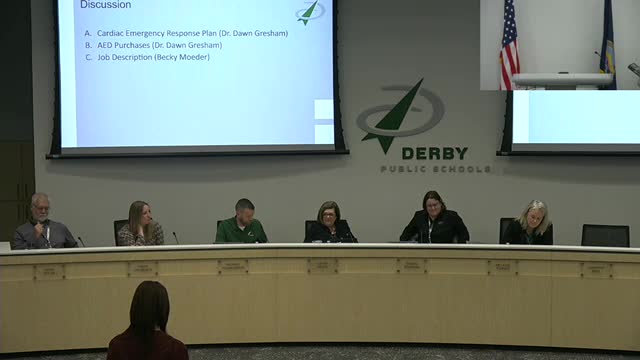
Board hears cardiac emergency response plan and proposal to put AEDs on buses; no purchase vote yet
Summary
District staff presented a cardiac emergency response plan required by state law and demonstrated an AED model. Administrators proposed buying additional AEDs—primarily to equip buses—and discussed training and monthly checks; board members raised questions about CPR training costs and device maintenance.
The Derby Board of Education reviewed a district cardiac emergency response plan on March 20, 2025, and saw a demonstration of an automated external defibrillator the administration proposes to purchase for buses and to replace older units.
Dr. Dawn Gresham, director of special services, said the plan responds to a state legislative requirement. "We were tasked with... Senate Bill 19," she said, and the plan aims to ensure trained responders and AED access so an automated device can be on a patient within three minutes of a cardiac emergency. The plan calls for an annual drill and for buildings to identify a cardiac emergency response team; nurses currently provide AED training for staff, Gresham said.
Administrators told the board the district currently has about 35 AEDs in buildings and is proposing to move to a single model and add units to transportation. The administration said it is recommending a total of about 105 AEDs across the district—replacing older devices and adding roughly 70 units for buses—so each bus would carry an AED. The district presented cost comparisons showing an estimated annual maintenance cost of about $72 per new unit versus about $167 per year for the older models under current maintenance contracts. Battery and pad life for the proposed devices was described as five years.
A vendor demonstration showed the proposed device's audio-visual prompts and a CPR-feedback feature that measures compression depth and provides real-time coaching. "It actually helps people that have not been trained in CPR...to do a better or higher-quality compression," the vendor said during the demonstration.
Board members pressed district staff on implementation details. One asked who would perform monthly checks of potentially 105 units and whether the head nurse could assume responsibility. Administrators said building staff already report beeping or errors and that a procedure will be assigned; they acknowledged the monthly checks create workload. Another board member asked why AED training is free while CPR certification incurs a per-person cost; staff said AED familiarization is offered by district nurses but that formal CPR certification carries fees and time requirements.
Administrators also discussed placing units at athletic sites, availability of portable units for off-campus events and that the devices can store event data for clinicians or emergency responders to review.
No procurement vote was recorded at the meeting. Administrators said they would return with purchase recommendations and budget details.