Get Full Government Meeting Transcripts, Videos, & Alerts Forever!
Get email alerts on the Attendance topic
No spam. Unsubscribe anytime.
Derby schools press attendance work as Cooper Elementary details supports; district reports mixed progress
Summary
Cooper Elementary outlined co-teaching, tiered attendance supports and an SRO outreach effort while district staff reported second-quarter chronic absenteeism rates; board members asked for calculation, notification and intervention details.
Rachel Eastman, principal of Cooper Elementary, told the Derby Board of Education on March 20, 2025, that Cooper has stepped up classroom co-teaching, tiered attendance plans and family outreach to try to reduce chronic absenteeism as the school remains above its target.
"We've had successes, but we're not on target yet," Rachel Eastman said, adding that Cooper's three-year trend shows progress but that the school was at about 18.3 percent chronic absenteeism when she prepared her presentation. Eastman described several new or expanded strategies: co-teaching to maximize adults in classrooms, quarterly academic and behavior goals, tier 2 and tier 3 attendance plans, family-engagement events with bilingual communications, and direct outreach by the school's SRO to some homes.
District staff presented the second-quarter chronic absenteeism report at the same meeting. "Our goal is to get to 12 to 13 percent," Dr. Holly Putnam Johnson said, citing the district target aligned with the state target. The report showed mixed results across buildings: Derby Hills at 10.8 percent at the end of quarter two; El Paso about 14 percent; Oak Lawn at 20.85 percent in quarter two (up from 18.5 in quarter one); Park Hill at 11.41 percent in quarter two; Stone Creek down from 12.26 in quarter one to 10.72 in quarter two; Swaney essentially flat; Derby Middle rising from 12.22 percent in quarter one to 16 percent in quarter two; Derby North at 19.21 percent in quarter two; and Derby High School at 21.18 percent in quarter two (up from 18.5 in quarter one). The presenter told the board that six schools were currently meeting or trending below their targets, that other schools were in a "possible range," and that one or two required closer monitoring.
Board members asked for operational clarifications. A board member asked how a day of absence is calculated; Putnam Johnson explained that at the middle school level a student must be present for five periods to count as a full day, at the high school three periods, and at the elementary level missing a half day counts as a full absence under the district's attendance accounting. She also said the district recently added attendance codes for early arrival and early dismissal to improve tracking.
Putnam Johnson described notification practices after students hit a 10 percent absence threshold. Staff used the Panorama system to identify families and sent letters in December to make parents aware that their child was reaching the chronic-absence threshold; the letter was intended as a prompt to reduce avoidable absences. She also noted a sharp decline in districtwide daily attendance during a pronounced flu period in late January when average daily attendance dropped to about 84.8 percent for the week cited.
Eastman and Putnam Johnson said Cooper and other schools are building individualized attendance plans, using school-based attendance teams and partnering with community resources for families who face transportation, medical or employment barriers. Eastman credited the SRO's readiness to conduct home visits as a high-impact intervention in some cases.
The board asked for an updated calculation of quarter three figures; Putnam Johnson said staff were computing those numbers and would return with updated data.
Votes at a glance
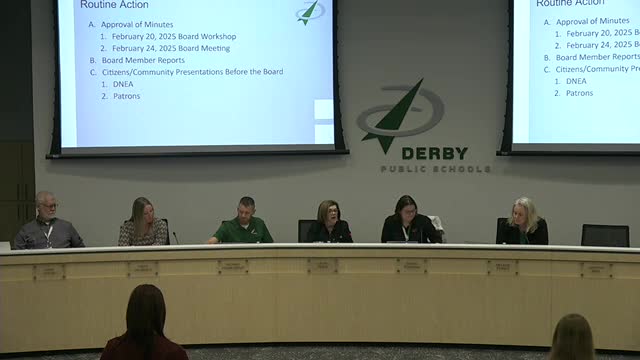
Several routine items were approved earlier in the meeting by unanimous votes recorded as 6-0. Those included approval of minutes from February 20 and February 24, approval of the consent agenda that listed donations to multiple schools and other routine personnel and claims matters, the district calendar change to implement summer hours (four 10-hour days from May 23 through July 18 with proposed closure dates included), and two modest strategic-plan text updates. The board also voted to enter an executive session on employer-employee negotiations (30 minutes after a five-minute break).