Get Full Government Meeting Transcripts, Videos, & Alerts Forever!
Get email alerts on the Redistricting topic
No spam. Unsubscribe anytime.
Rules committee sends HF550 (redistricting commission amendment) to general register after debate on partisanship and deadlock
Summary
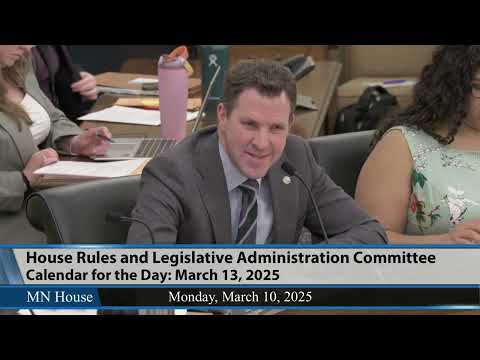
A Minnesota House Rules and Legislative Administration Committee vote on March 11, 2025 sent House File 550 — a proposed constitutional amendment to create a redistricting commission — to the General Register by an 8-6 roll-call vote, after extended public testimony and debate over whether the proposal is partisan and lacks a remedy for commission deadlock.
A Minnesota House Rules and Legislative Administration Committee vote on March 11, 2025 sent House File 550 — a proposed constitutional amendment to create a redistricting commission — to the General Register by an 8-6 roll-call vote, after extended public testimony and debate over whether the proposal is partisan and lacks a remedy for commission deadlock.
The bill’s author, Representative Torkelson, presented HF550 as a constitutional amendment that would place a redistricting commission before voters. He said the commission is intended to provide a new process for drawing legislative and congressional district lines and to reduce extreme partisanship in redistricting. "The need for a redistricting commission is obvious," Representative Torkelson said during closing remarks. "We should all be very frightened of a trifecta." (Representative Torkelson, Committee member)
Why it matters: The committee hearing drew multiple advocacy groups and community organizers who urged revisions. Testimony from nonprofit and community groups focused on three recurring concerns: the commission’s composition and whether it would entrench partisan control; the absence of a specified backstop if the commission deadlocks; and limited details on how public hearings and outreach would be sequenced across the state.
Public testimony and members’ concerns
Several witnesses representing civic organizations and community groups told the committee HF550, as drafted, favors party control of appointments and lacks sufficient transparency or safeguards for minority communities. Tom Wiesen, a Mahtomedi resident, urged the committee to "table this bill ... it is not ready for prime time," saying the author had not consulted broad stakeholders. (Tom Wiesen, resident)
Paul Luffin, who identified himself as an elections and redistricting policy coordinator for a civic group, told the committee the bill "does not specify the number, the manner of the hearings, [or] locations of hearings ... ensuring that all of the people in Minnesota ... have the opportunity to comment." (Paul Luffin, Elections and Redistricting Policy Coordinator)
Anastasia Belleron, executive director of Common Cause Minnesota, said HF550 does not create an independent commission and instead risks a two‑party dynamic that can replicate partisan gridlock. Mary Hartnett of Clean Elections Minnesota and Mei Yang of the Minnesota Council on Foundations echoed concerns about community participation, transparency and the absence of a defined court or statutory remedy for commission deadlock. Walter Fromm of Take Action Minnesota and Rich True of the Forward Party of Minnesota also urged a more inclusive, less partisan approach.
Members debated the proposal’s design and safeguards. Representative Coulter pressed the author on remedies for a deadlock and on the bill’s limited exclusions for who can serve on the commission. "What happens if they can't get to those six votes?" Coulter asked, noting the bill as written offered no specific remedy. Representative Torkelson said the question of a deadlock remedy is an outstanding issue he is "interested in taking more input on," and that his objective is to "put as much pressure on this commission as possible to actually reach an agreement." (Representative Coulter; Representative Torkelson)
Representative Long (Leader Long) offered an alternate amendment (DE2) that would have created a different, more independent commission structure with additional conflict‑of‑interest screens and a different appointment method. The committee voted on the DE2 amendment; the roll‑call result was 5 ayes and 8 noes, and the amendment did not prevail. (Motion by Representative Long; roll call recorded in committee minutes.)
Procedural motions and final action
- The committee voted 8-6 to send HF550 to the General Register (motion carried). The roll call recorded eight ayes and six nays. - Leader Long moved to lay HF550 over for further work; that motion failed on a roll call (6 ayes, 8 nays). - Leader Long’s DE2 amendment, intended to create a more independent commission with screening rules for appointees, failed on a roll call (5 ayes, 8 noes).
Discussion vs. decision
The hearing recorded extensive discussion and public testimony that urged additional safeguards and broader community engagement. The committee’s vote to re‑refer HF550 to the General Register is a procedural step that places the bill on the calendar for potential floor consideration; it does not adopt the amendment or finalize substantive bill language. Several members said they expect continued negotiation on commission composition and conflict‑of‑interest rules if the bill moves forward.
Votes at a glance
- Motion to adopt calendar for Wednesday, March 12, 2025 (5 bills listed): Passed, 8 ayes, 6 nays. (Adopted by committee.) - Motion to adopt calendar for Thursday, March 13, 2025 (17 bills listed; prefiling requirement adopted for House Files 24 and 25): Passed, 8 ayes, 6 nays. (Committee established prefiling requirement for HF24 and HF25; other bills had no prefiling deadline.) - DE2 amendment to HF550 (Representative Long): Failed, 5 ayes, 8 noes. - Motion to lay HF550 over (Representative Long): Failed, 6 ayes, 8 nays. - Motion to re-refer HF550 to General Register (Representative Torkelson): Passed, 8 ayes, 6 nays. Outcome: HF550 re‑referred to the General Register for potential future floor action.
What the bill does and what remains unresolved
HF550 proposes a constitutional amendment to create a redistricting commission appointed by legislative leaders. The bill’s author said the commission would place the redistricting question before voters by amending the Minnesota Constitution. Testimony and member questions focused on: (1) commission composition and the role of party leaders in appointments; (2) lack of specific requirements for statewide, geographically dispersed public hearings; (3) sparse restrictions on who may serve (for example, whether lobbyists or recent elected officials would be disqualified); and (4) the absence of a clearly defined mechanism if the commission cannot agree on a map.
Officials and witnesses asked for amendments to add clearer public‑participation rules, stronger conflict‑of‑interest screens, and an explicit deadlock remedy or judicial role. Representative Torkelson stated the bill is a work in progress and said he would accept additional input.
Ending
HF550 now goes to the General Register; the committee’s action does not finalize the constitutional language. Additional committee negotiation or floor debate will be necessary to address the questions raised in testimony and during member discussion before any final change to the Minnesota Constitution could be adopted or presented to voters.