Get Full Government Meeting Transcripts, Videos, & Alerts Forever!
Get email alerts on the Public Art topic
No spam. Unsubscribe anytime.
Miami staff: public‑art fees for Miami Freedom Park trigger at master building permits; stadium master expected in 4–6 months
Summary
City planning staff told the Art in Public Places Board that public‑art fees for Miami Freedom Park will be calculated and collected when developers obtain master building permits for each structure, and that the stadium master permit is likely four to six months away.
City planning staff told the Art in Public Places Board on a project update that the city will assess and collect public‑art fees for Miami Freedom Park when developers secure master building permits for each structure on the site, not at earlier phase or foundation permits.
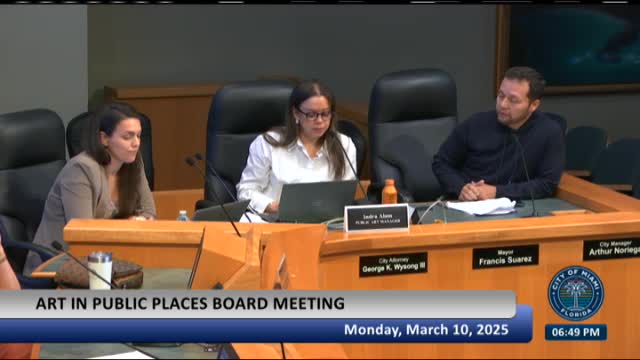
Indra, a planning department staff member who led the presentation, said the Miami 21 zoning code requires collection “prior to issuance of a master building permit,” and that for a large multi‑structure project such as Miami Freedom Park it is practical to calculate fees at master permit stage so the city can capture the project’s full construction and design value together.
Efren, a developer representative who attended the meeting, and Indra described the permit breakdown the planning division is tracking: entitlement approvals, phase/foundation permits that allow early work, and master permits that cover a finished structure. Staff said roadway/drainage, the parking garage and a chiller master permit application are currently under review; no master permit has yet been issued for the stadium. Based on the current review cycle, staff estimated the stadium master could be issued in roughly four to six months.
Staff told the board the public‑art fee will be triggered separately for each master permit—so the stadium, garage, roadwork and retail buildings will each carry an individual public‑art obligation proportionate to that structure’s assessed value. Indra said values shown in building‑permit records reflect construction cost only and will understate the fee base if design fees and other project costs are excluded; staff plans to obtain a project allocation worksheet from the applicant to capture construction and design components when calculating the fee.
Board members asked how the city will ensure compliance and how the art will be selected and integrated. Indra said the Art in Public Places (AIPP) division is flagged by the building department during permit review; AIPP provides a project allocation worksheet to the applicant, reviews submitted cost information in cycles, and will withhold permits until code requirements are satisfied. She said the planning division expects to collect fees and either accept in‑lieu payments into the public‑art fund or require in‑kind installation, and—based on how similar large projects have been handled—recommended the city collect fees and manage the public‑art program for the site rather than leave selection entirely to the applicant.
On the scale of the project, staff said an earlier estimate produced about $27 million in total public‑art obligations using price levels from several years earlier; staff reiterated that amount is an estimate and that the final fee will be calculated from master permit values and the applicant’s allocation worksheet. The board asked staff to provide regular monthly updates of the permit‑status chart, including the dollar value shown on each building permit, noting that permitted values will likely be lower than the final verified project value.
Indra and Efren said the city and applicant have begun discussing how public art could be integrated into plazas, the stadium, a large central park and rooftop elements on the garage; staff said they are reminding the applicant of the requirement and will collaborate with the design team and AIPP to identify locations and timelines for artist calls or other selection methods once fees are secured or in‑kind work is proposed.
The planning division emphasized it is responsible for tracking and enforcing the public‑art requirement during permitting, and that AIPP will provide formal review when master permits are flagged by building for final compliance checks.