Get Full Government Meeting Transcripts, Videos, & Alerts Forever!
Get email alerts on the Animal Services Fee Update topic
No spam. Unsubscribe anytime.
Commission overseeing Tulsa Animal Services recommends updated fee schedule, citing 2008 rates and rising costs
Summary
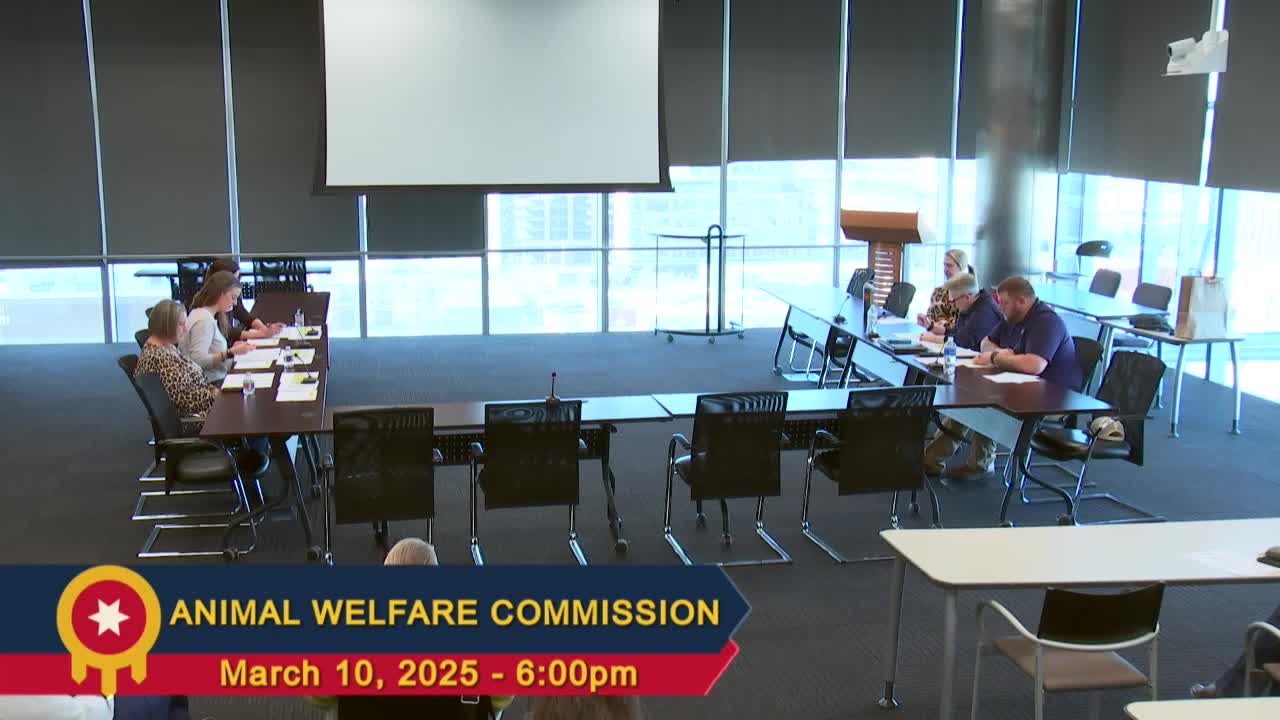
At a March 10 meeting of the commission that oversees Tulsa Animal Services, commissioners voted to recommend a package of fee increases and administrative changes to the City Council, saying the department’s fee schedule had not been updated since 2008.
At a March 10 meeting of the commission that oversees Tulsa Animal Services, commissioners voted to recommend a package of fee increases and administrative changes to the City Council, saying the department’s fee schedule had not been updated since 2008.
The fee list, presented by Sherry Carrier, manager, and Colton Jones, operational manager, would raise impound and daily-care charges, add a one-time rabies observation fee, increase the sterilization deposit, and restructure commercial-animal-permit costs. "This fee list has not been altered since 02/2008," Sherry Carrier said during the presentation.
The commission chair, Commissioner Christine Coonsweiler, moved to accept the proposed fees; the motion was seconded and carried. Commissioners also approved routine minutes earlier in the meeting.
Why it matters: City staff said the proposals are intended to bring the shelter’s fee schedule in line with two decades of higher personnel and operating costs and to recover more of the consumables and outside-veterinary costs that the shelter has been absorbing. Colton Jones said rising employee costs, fuel and vaccinations were factors that “put us way behind the mark.” The commission will forward its recommendation to the City Council, which must approve any ordinance or official fee change.
What’s in the proposal: The packet presented to the commission includes multiple line-item changes and procedural clarifications. Among the substantive changes discussed: - Small-animal impound fees would rise, with the small-animal impound fee noted in the presentation as increasing to $50; daily housing fees for animals would also increase. - The sterilization deposit would increase from $150 to $250, in line with a newly announced citation amount, to help recoup the city’s costs for spays/neuters when animals are reclaimed. - A new one-time rabies observation fee would be charged for animals quarantined after biting incidents; staff clarified the charge would be a single fee for the observation period rather than a per-day charge. - Large-animal handling is clarified: the shelter will continue to contract with Collinsville Livestock for cattle and horses and will add a daily fee for large-animal livestock to reflect what the city pays that partner under the MOU. - Adoption fees will be consolidated into single, all-inclusive adoption charges (covering spay/neuter, microchip, rabies, city license and other routine services) rather than multiple separate line items on a receipt. - Permit fees for commercial animal establishments would increase substantially: the proposed initial permit for Type A establishments (boarding, grooming, etc.) would be $300 with a $200 renewal; Type B (animal wholesalers/pet lands) would carry a $500 initial permit and $300 renewal. Exemption permits and hobbyist categories would be reclassified to reflect their actual permit types. - Euthanasia: the proposal removes a prior nonresident euthanasia fee and directs owner-requested euthanasia cases toward the Tulsa SPCA partner for service; staff said the shelter will not continue to charge for euthanasia as a routine service for nonresidents.
Discussion highlights and community concerns: Commissioners and commentators pressed staff on implementation details. A veterinary commenter identified as Tim, speaking from clinical experience, noted historically low license compliance and asked whether veterinarians might collect the city license fee; staff said the current finance system does not integrate with the shelter’s software and that cities vary in whether veterinarians collect the fee. Sherry Carrier said the shelter has a request in to obtain three years of revenue data for the license fee and is discussing software modernization that could enable web licensing.
Public comments emphasized spay/neuter access. Patty Mandrell, who spoke during public comment, urged stronger city action on spay/neuter to address intake driven by intact animals and called for increased low-cost options; an animal-services speaker and staff noted the department and partners are pursuing options and outreach to reduce overpopulation.
Conditions and next steps: Commission members and staff said the recommendation is a step toward updating an outdated schedule, but final effect depends on City Council action. "We'll be proposing this to the City Council," Carrier said; she did not specify a hearing date. Staff also told the commission they would notify members on the day the proposal goes before the council.
Implementation notes: Staff said the shelter accepts credit card, cash and check at the downtown facility and that a credit-card machine is available for license and fee payments. Staff reiterated that the finance department’s current payment-processing system and the shelter’s case-management system do not currently communicate, which complicates citywide license collection through veterinary clinics.
The commission emphasized offsets and incentives in the proposal: owners who microchip or tag animals or who register livestock brands would receive reduced impound or reclaim fees, and the revised permit structure seeks to apply costs to operations that require more staff time and inspections.
The commission’s vote on the fee recommendation was procedural only: commissioners recommended the schedule to the City Council for review and possible ordinance action; the council must authorize any final fee changes.