Get Full Government Meeting Transcripts, Videos, & Alerts Forever!
Get email alerts on the Board Procedure topic
No spam. Unsubscribe anytime.
BZA receives annual training on variances, special exceptions and quasi-judicial procedures
Summary
Planning staff provided the Board of Zoning Appeals an annual training covering the board's quasi-judicial role, relevant Indiana statute, the town's Unified Development Ordinance, variance criteria, special exceptions, administrative appeals and best practices on recusals, notices and conditions.
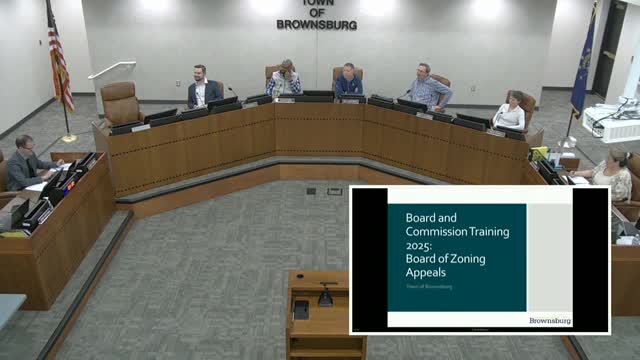
At the March 10 meeting the Town of Brownsburg Board of Zoning Appeals received its 2025 annual training on roles, procedures and case law from planning staff and legal counsel.
Staff framed the BZA as a quasi-judicial board focused on variances, special exceptions and appeals of administrative determinations under local and state law. Planning staff reviewed the role of the Unified Development Ordinance (UDO) and the state statute that governs planning procedure, noting Indiana Code 36-7-4 as the higher-level statutory authority for many planning processes.
The presentation reviewed common case types the board decides: development-standards variances (three statutory criteria), use variances (including unnecessary-hardship analyses), special-exception uses and administrative appeals of staff interpretations. Staff emphasized the centrality of the UDO's definitions and the requirement that findings trace back to the applicable criteria.
Key procedural guidance
Staff and legal counsel advised board members to avoid ex parte contacts on pending matters, to announce recusals when required by the board's rules of procedure, and to keep a clear record that ties decisions to the board's findings. They recommended that if the board needs additional evidence before deciding it should consider continuing the public hearing so the public need not be re-noticed. Staff also explained that applicants receive the filing packet (including their initial statement of reasons) at submission and are encouraged to supplement their evidence before public notice goes out.
On conditions and commitments, staff distinguished conditions (requirements that must be satisfied as part of the approval and are typically verified during permitting) from commitments (longer-term obligations that run with the land). The presenters cautioned the board to keep conditions narrowly tailored to the project and to avoid imposing obligations on adjacent property owners.
Case-law examples and standards
Legal counsel reviewed several cases as examples of how courts evaluate BZA decisions, including examples described in the presentation as involving revocation following inadequate notice, practical-difficulty analyses for solar and other projects, and approvals that were later found to be arbitrary and capricious when based on incomplete applications. Counsel summarized the arbitrary-and-capricious standard as: a decision may be overturned if it is patently unreasonable, made without consideration of the facts, or lacks a basis that would lead a reasonable person to the same conclusion.
Why this matters
The training reinforced that BZA decisions must be grounded in the UDO and statute, that detailed findings help withstand legal scrutiny, and that thorough evidence from applicants (traffic counts, engineering, insurance risk assessments when relevant) supports clear decision-making. Staff said they will distribute the training slides and reference materials to members after the meeting.
Staff noted trends in filings: 13 BZA cases in 2024, a decline from prior years, with development-standards variances forming the largest share of matters in recent cycles.
"If you have a case come up where you can't be unbiased about it, you should recuse yourself," planning staff said. "When you are making a motion especially to deny, you want to cite the criteria and the record so that the reasoning for the denial is clear."