Get Full Government Meeting Transcripts, Videos, & Alerts Forever!
Get email alerts on the Land Use Construction Staging topic
No spam. Unsubscribe anytime.
Council approves five‑year special‑use permit for contractor staging yard at 319 E. U.S. 80 with conditions
Summary
The Sunnyvale Town Council approved a temporary special‑use permit allowing Austin Bridge and Road to use roughly 14 acres at 319 E. U.S. 80 as a staging/storage yard tied to a nearby highway construction contract, adding restrictions on lighting, fencing, dust control and storage.
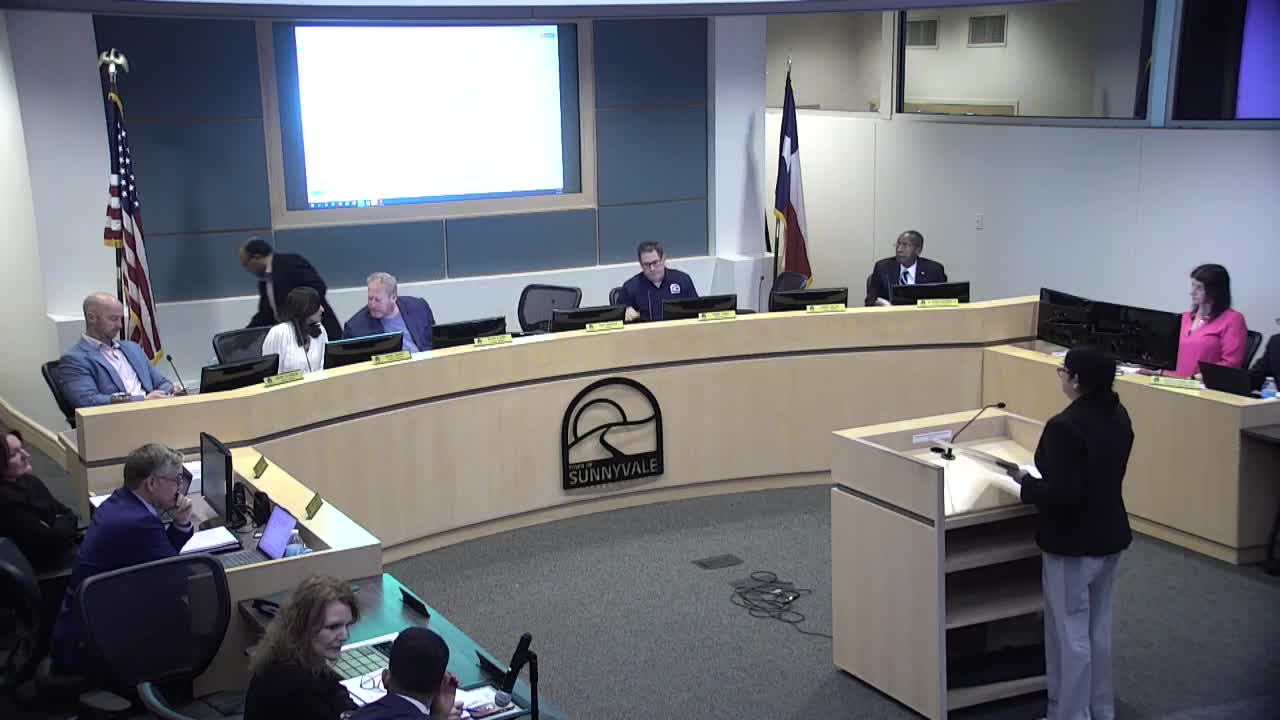
The Sunnyvale Town Council on March 10 approved a temporary, five‑year special‑use permit (SUP) allowing a contractor to use a 14‑acre portion of 319 East U.S. Highway 80 as a staging and storage yard for a TxDOT highway project, subject to multiple conditions intended to limit lighting, dust, visual impacts and material storage.
The applicant identified at the meeting was Austin Bridge and Road; Joel Asich addressed the council as the applicant’s representative. Shuru Pesen, Director of Planning and Development, presented the request and recommended approval for a five‑year term because the staging use is tied to the construction project and not intended as a permanent land use.
Key conditions the council added or confirmed before approving the SUP include: - No loose dirt, gravel or similar bulk material may be stored on the site for long‑term stockpiling. - An 8‑foot PVC‑coated chain‑link fence with privacy screening (windscreen) is required along the east, west and south sides of the designated area; the council discussed and rejected placing full wood fencing on all sides because of maintenance and structural concerns. - Lighting limited to no more than eight poles, each not to exceed 30 feet; luminaries must be shielded and a photometric plan showing maximum illumination at property lines (not to exceed 1 foot‑candle) must be submitted for planning director review. - A daily minimum watering/maintenance plan to control dust, with increased frequency during dry months; the applicant must have access to a water truck or water source to maintain suppression. - Tree mitigation via an escrow agreement: the applicant will deposit funds tied to caliper inches removed; at SUP expiration the applicant may replant or the town may use the escrow funds to replant on town property.
Site and operations details presented at the meeting: staff described roughly 101 employee parking spaces near the trailers, additional parking for construction vehicles, and a staging area toward the rear of the property for Connex (shipping) containers and weather‑sensitive materials such as electronic message boards and signs. The applicant estimated two to three 18‑wheelers would access the site per week during the project; office hours were stated as roughly 6 a.m. to 6 p.m. with limited night office activity and night roadwork occurring in the project right‑of‑way.
Council discussion and vote: Council members debated fencing material and visual screening. After multiple motions and amendments, the council approved the SUP with the conditions above. The final council vote was 6–1 in favor; Councilmember Clark voted against the SUP.
Why it matters: The SUP allows construction staging tied to a state highway project but places specific limits intended to protect nearby residences in the Bridal Lake area and reduce long‑term impacts on town parkland and rights‑of‑way. Staff said the SUP will terminate automatically at the end of the five‑year period unless the applicant pursues a renewal through the SUP process.
Ending: Staff said they will monitor compliance through normal code‑enforcement channels and can bring alleged violations to council for revocation if necessary. The applicant and staff also agreed to finalize technical details — the photometric lighting plan, irrigation/dusting schedule and the escrow tree‑mitigation paperwork — before operations begin. The council recorded that trailers could be operational within weeks, with the applicant saying trailers were targeted to be operational by mid‑April.