Get Full Government Meeting Transcripts, Videos, & Alerts Forever!
Get email alerts on the School Safety topic
No spam. Unsubscribe anytime.
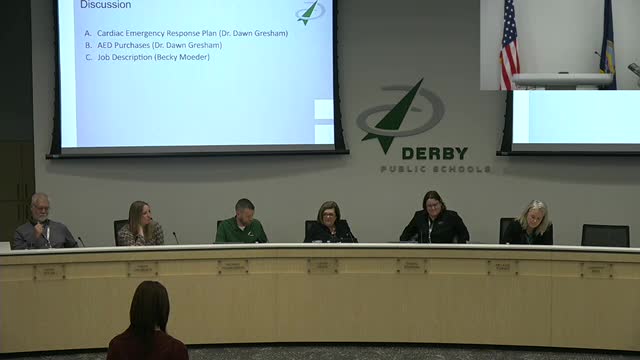
Derby Board reviews cardiac emergency response plan and discusses buying 105 AEDs for schools and buses
Summary
Administrators presented a state-required cardiac emergency response plan and a vendor demonstrated an intelligent AED. The board discussed placing AEDs on buses, monthly checks, training costs and legal protections; no formal purchase vote was taken at the meeting.
Dr. Dawn Gresham, the district director of special services, presented the Derby Public Schools’ cardiac emergency response plan on March 20, 2025, telling the board the plan is being developed to meet a state requirement in Senate Bill 19 that districts prepare for cardiac emergencies.
The presentation described certified cardiac response teams in each building, AED registration through PulsePoint, annual drills and a goal of applying an AED within three minutes of a cardiac event. Vendor Dwayne Billinger demonstrated a proposed AED model that includes guided, audiovisual CPR feedback and a “child” setting that removes the need for separate pediatric pads.
The district discussed buying 105 new units—mainly to place AEDs on buses and to standardize equipment across buildings—while replacing older models now nearing end of life. Dr. Gresham said replacing older devices would lower annual maintenance costs: about $72 per unit per year for the proposed model versus roughly $167 per unit per year for the existing devices. She also described plans for monthly checks of all units and registering locations so 911 dispatchers can direct emergency responders to the nearest AED.
Board members asked about who would perform monthly checks and whether the district should expand CPR certification beyond that subset of staff designated as cardiac responders. Several members raised cost and time concerns for CPR certification of all classified and certified employees; Dr. Gresham said AED training is provided locally by the district nursing staff and that full CPR certification for broad groups would add both time and expense. The district clarified that Good Samaritan protections apply to staff who render emergency aid.
Billinger demonstrated the AED’s user interface and CPR-feedback feature, noting that the device “will walk you through CPR” and gives real‑time guidance on compression depth and rate, which the presenters said can help both trained and untrained rescuers deliver higher‑quality compressions. Board members pressed about coverage at offsite athletic locations and the stadium/track, and Dr. Gresham said some portable arrangements and additional units would be needed to meet the three‑minute target in some venues.
No formal purchase motion was recorded on March 20; district leaders said they would bring an itemized purchase proposal and pricing back to the board for action at a later meeting.