Get Full Government Meeting Transcripts, Videos, & Alerts Forever!
Get email alerts on the Solar Programs topic
No spam. Unsubscribe anytime.
Austin Energy details solar programs, $32M Solar For All grant and 9 MW in standard-offer applications
Summary
Austin Energy staff briefed the Electric Utility Commission on a portfolio of solar and renewable programs and on a federal grant that the utility plans to use to expand solar access for low‑income customers.
Austin Energy staff briefed the Electric Utility Commission on a portfolio of solar and renewable programs and on a federal grant that the utility plans to use to expand solar access for low‑income customers.
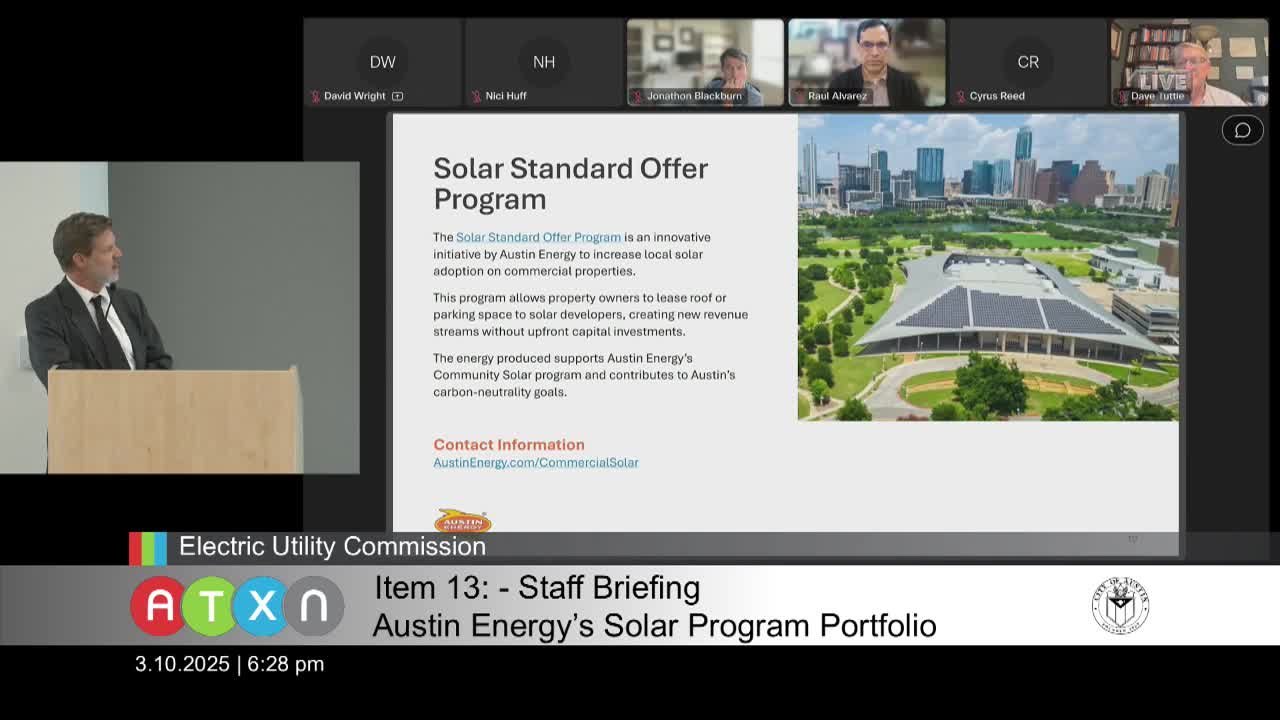
The commission heard that the utility’s suite of customer-facing programs includes the long-running Green Choice subscription (wind), a community solar subscription model (half of current capacity reserved for low‑income subscribers), a new solar standard-offer for commercial hosts, incentives for commercial and multifamily customers and homeowner incentives tied to an education course. Tim Harvey, Austin Energy’s customer renewable solutions manager, told the commission: “The solar standard offer program has gotten off to a really good start. It’s, currently has 20 applications for 9 megawatts.”
The nut of the briefing was Austin Energy’s plan to use federal grant funds to expand access and resilience for low‑income customers and to grow local capacity. Staff emphasized the programs are part of the utility’s role in carrying out the Resource Generation and Climate Protection Plan and in meeting equity and resilience goals.
Austin Energy described program details and near‑term priorities. Highlights include:
- Green Choice: a subscription product in operation since 2001 that sells Green‑e certified wind energy to residential and commercial customers; business options include month‑to‑month, one‑year and five‑year commitments. Residential participation is described as a small-premium subscription (about three‑quarters of a cent per kWh, which staff estimated at roughly $7.50 a month).
- Community solar: a local portfolio of projects on the distribution system; staff said the program design reserves roughly half the capacity for low‑income customers at no up‑front cost and that early subscribers who locked in prices now pay less than other customers in some cases. Staff said community solar will be expanded using projects coming online under the solar standard offer.
- Solar standard‑offer (commercial): the new program launched in mid‑January; staff reported it currently has 20 applications representing about 9 AC megawatts. The standard‑offer is intended to enable building owners and third‑party developers to receive a predictable payment from the utility even when the building tenant is the electricity account holder.
- Commercial and multifamily incentives: performance‑based incentives (paid over five years based on actual PV production) and capacity‑based upfront incentives for nonprofits and small businesses. Staff said they expect a record year for commercial installations. Multifamily programs can use an aggregation and allocation approach so generation on a master meter or at multiple interconnections can be apportioned to individual tenant bills.
- Residential incentives and education: homeowners take a short solar education course and quiz, then become eligible for a $2,500 incentive plus the ongoing value of solar credit for production.
- Solar For All (EPA grant): staff described an EPA grant Austin Energy plans to use to install solar and batteries targeted to communities of need. Tim Harvey summarized the planned scope: about 18 megawatts of solar and 30 megawatts of batteries (roughly 40 megawatt‑hours), installed on approximately 2,500 residential hosts and 50 commercial hosts. The utility said the work will enable 3,000 low‑income subscribers to receive roughly 20% bill savings for 15 years and that ownership of installed systems would transfer to hosts at no cost after the 15‑year grant term. On timing, staff said: “this will be launching in 2026. That’s when we will start putting these in.”
Staff also described the federal funding and reimbursement process: an executive order briefly paused some federal disbursements last year, but the agency reimbursement tool is currently available and Austin Energy is submitting claims for reimbursement. Staff cautioned federal funding remains a potential risk and that the utility is prioritizing grant compliance so reimbursements are not jeopardized.
Staff emphasized workforce development and community engagement as program components. Austin Energy said it is coordinating with the city’s economic development department and the mayor’s infrastructure academy to build a paid workforce pathway and will hire paid community ambassadors to do outreach. Staff said the program will include education for hosts about limits to resiliency from a single rooftop system and that battery-backed systems will provide whole‑home backup but require customers to conserve energy during outages to extend autonomy.
Commissioners asked about how hosts and subscribers will be selected. Staff said installations funded by the grant must be located in concentrated areas of poverty (the grant’s targeting requirement) and that hosts will be selected based on suitability for solar (roof condition, shading, etc.). Income‑qualified subscribers who receive the 20% bill discount may be located outside those targeted census areas; staff said subscription eligibility is based on income qualification, and that subscriber queues and prioritization rules will be set during stakeholder engagement.
Staff also said the Solar For All grant includes three grant‑funded FTEs to help deliver the program; Tim reported his team currently has 10 FTEs, two contractors and one temporary FTE assigned to customer renewables work.
Ending: Staff said they will hold stakeholder meetings on program design and community engagement and will return with additional implementation details. Commissioners said they plan to track rollout and workforce plans as the programs move toward 2026 deployment.