Get Full Government Meeting Transcripts, Videos, & Alerts Forever!
Get email alerts on the Special Education topic
No spam. Unsubscribe anytime.
Parents urge Mustang Public Schools to reverse dissolution of Lake Houma social‑sensory classroom
Summary
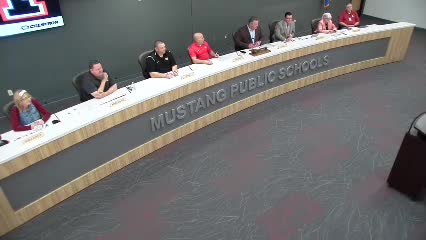
Parents and caregivers urged the Mustang Public Schools Board of Education to reverse the district’s decision to dissolve the social‑sensory classroom at Lake Houma Elementary and the boost program for students with intense behaviors, saying the change was announced by email with no prior parent meeting or clear plan.
Parents and caregivers urged the Mustang Public Schools Board of Education to reverse the district’s decision to dissolve the social‑sensory classroom at Lake Houma Elementary and the boost program for students with intense behaviors, saying the change was announced by email with no prior parent meeting or clear plan.
At the meeting, Sarah Coles, a Mustang employee and parent, described the impact on families and students and said she verified with the Oklahoma State Department of Education (OSDE) that no state mandate required the program’s removal. “How did families find out that their child's classroom, their safe space, their structured learning environment, their community was being taken away? Through a cold, uncompassionate email from district administration,” Coles said. “There was no meeting with parents beforehand, no explanation, no plan.”
Allison Beffert, another Lake Houma parent, urged the board to consider federal special‑education protections, arguing the current classroom provides students a legally appropriate, data‑driven placement. “This class…is a sensory support classroom. It’s a blend of honoring the unique styles of learning of each student, social‑emotional skill building, as well as helping students develop independence at their own pace,” Beffert said. “Failure to implement [IEPs] properly would put providers out of compliance, which is essentially in the state of Oklahoma breaking the law.”
Parents told the board the changes would force students back into home schools or other settings that they said lacked the staff, structure and training to meet those students’ sensory and behavioral needs. Coles and Beffert said the district’s plan reduces direct support: parents reported that new classrooms would have “only 2 pair of paraprofessionals split between 3 classrooms” instead of the larger teams students have had, and that some students could be placed in mild/moderate or functional skills rooms that serve different age ranges and educational profiles.
District officials responded that the change was prompted by state guidance on program structure. Superintendent Charles Bradley told parents the district had sought ways to serve more students with autism and had been advised by Sherry Coates, director of special education at OSDE, that “we cannot create programs that are based on the disability that that is a violation of IDEA,” referencing the federal Individuals with Disabilities Education Act. Bradley said the district’s goal remains “integration back to the home site” with supports, and that staff would follow up with parents with more details about how supports would be provided at individual home sites.
Board members and the superintendent said they would continue communication and follow up individually with parents. Coles and Beffert asked the board to reassess the decision and to provide clear, individualized plans for each affected student’s least restrictive environment and implementation of IEPs.
No formal action to change the decision was recorded at the meeting; parents said they will press the board for further review and clearer plans for staffing, training and placement.
Ending — The district said it will contact parents for follow‑up and clarify what supports will accompany any site changes; parents said they will seek reassessment to ensure students’ IEPs and least restrictive placements are preserved.