Get Full Government Meeting Transcripts, Videos, & Alerts Forever!
Get email alerts on the Healthcare Workforce Loan Repayment topic
No spam. Unsubscribe anytime.
Lawmakers hear broad support for loan‑repayment program to recruit nurses, respiratory and imaging technologists and dentists
Summary
Hospital leaders, unions, educators and professional societies urged the Public Health Committee to adopt or fund a loan‑repayment program and other recruitment measures for nurses, APRNs, respiratory therapists, radiologic technologists and dental professionals to address persistent shortages, particularly in rural and underserved areas.
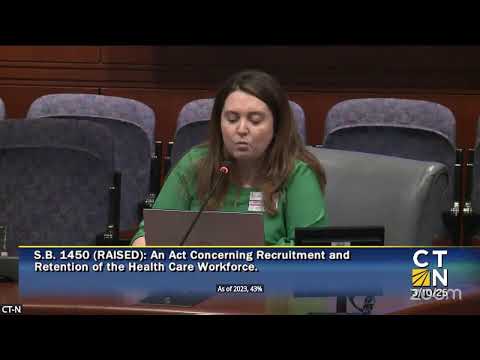
Senate Bill 1450 proposes a statewide student loan repay‑and‑recruit program for licensed health care professionals employed full time in Connecticut. The Public Health Committee received broad, multi‑sector support for that proposal at the March 10 hearing, with detailed testimony on shortages in nursing, respiratory care, radiologic technology and dental care.
What witnesses said: Multiple hospital systems and the Connecticut Hospital Association backed a loan‑repayment program, saying the state needs a competitive tool to retain and recruit clinicians. Nurses from Backus Hospital told the committee that chronic staffing shortfalls and low local wages have driven turnover; one nurse reported a 70 percent turnover rate over four years at her hospital. Respiratory therapists, radiologic technologists and nuclear medicine technologists testified that training pipeline capacity is constrained by insufficient clinical sites and predatory out‑migration to neighboring states with more generous incentives. Dental advocates said Connecticut already has many dental “deserts” and urged specific inclusion of dental providers in recruitment funding.
Program design questions: Testimony raised implementation issues: should the program target only public or nonprofit employers, what length of service would be required, and how should funds be prioritized geographically? The committee heard that physician reciprocity and APRN transition‑to‑practice rules are also contributing to recruitment friction; the Connecticut APRN Society asked for APRN reciprocity to recognize experienced out‑of‑state APRNs more quickly.
Education & pipeline solutions: Educators from university and community‑college programs said expanding enrollment is possible if there are more clinical training placements and financial supports for schools and instructors. Task forces on radiologic and respiratory workforce recommended compensating clinical instructors and funding expanded program capacity.
Ending: Lawmakers and advocates described loan repayment as one practical, immediately actionable lever to stabilize the workforce, while acknowledging it must be combined with training capacity investments, improved clinical placement support and state‑level coordination to have sustained impact.