Get Full Government Meeting Transcripts, Videos, & Alerts Forever!
Get email alerts on the Home Health Safety Workforce topic
No spam. Unsubscribe anytime.
Home‑health safety and workforce bills expose split over smoke‑detector mandate and lift support for loan‑reimbursement and reporting changes
Summary
Lawmakers heard bipartisan support for loan‑repayment and training investments to recruit and retain nurses and allied health professionals, while a proposed requirement that home‑health agencies arrange installation of working smoke detectors drew near‑universal opposition from providers and agency groups.
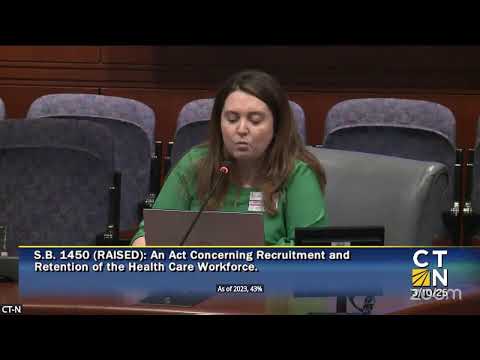
Lawmakers heard hours of testimony on two related items: SB 1450, a broader workforce recruitment and retention bill that would among other things create a student loan repayment program for health care providers; and SB 1451, the working‑group follow‑up that codifies safety reporting, intake disclosures, and monthly staff checks for home‑based care. The hearing highlighted near‑unanimous support for loan‑repayment ideas but sharp disagreement about a proposed requirement to verify and install working smoke detectors in private homes where a licensee provides services.
Loan repayment and workforce provisions: Hospitals, community health centers, home‑care agencies and individual clinicians overwhelmingly supported the proposal to create or extend loan‑repayment and tuition assistance as a recruitment and retention tool. Testimony from hospital and community providers and workforce task‑force members — including representatives of the Connecticut Hospital Association, Connecticut Association for Health Care at Home, community health centers, and professional societies for radiologic and respiratory technologists — documented shortages in nursing and allied fields and described loan repayment as an important, feasible recruitment lever. At least one witness estimated the average dental graduate’s education debt at roughly $300,000; other witnesses cited respiratory therapists and radiologic technologists as high‑priority shortage areas.
Safety and reporting: SB 1451 (the working‑group bill) would require that referral sources (hospitals, clinicians or other agencies) provide known safety‑relevant information — for example, prior history of violence or substance misuse — to agencies that send caregivers into private homes. Providers and agency leaders supported the change as a way to reduce surprises and to plan escorts or other protections. Witnesses also asked the legislature to clarify that monthly staff safety assessments can be completed by phone, email or other non‑in‑person means to reflect workflow realities.
Smoke‑detector mandate (contentious): Section 4 of SB 1450 would require home‑health agencies to ensure private homes have working smoke detectors, and, if not, to arrange for their installation. Agencies, home‑care providers and the Connecticut Association for Health Care at Home opposed that provision across the hearing, calling it outside the agencies’ scope and a misplaced enforcement responsibility. "We provide medical care, not make code‑enforcement visits or install devices in private homes," said Chris Pankratz of Masters in Home Care; Day Kimball, CHA and other agency leaders made similar points. Providers said the requirement would introduce liability and cost burdens, possibly delay care, and not solve the larger housing and code‑compliance problems.
Support for smoke‑detector goals but not the approach: Several witnesses, including legislators, said the tragic death of a 24‑hour caregiver in an East Lyme housefire made the safety point painfully clear and urged action; agency leaders said they share the safety goal and asked the committee to pursue collaborative alternatives such as partnering with local fire departments, centralized referral databases, targeted grants for at‑risk households, pilot programs or public‑education campaigns rather than placing installation or enforcement duties on clinicians and licensed agencies.
Escorts, data and practical fixes: Agencies and frontline nurses urged clearer, feasible mechanisms to document prior incidents and near misses. Witnesses said existing public sources (judicial searches, sex‑offender registries) are incomplete, difficult to match and often return false positives based on name collisions. Several witnesses recommended a centralized, state‑maintained database or hotline so agencies could check for safety flags quickly; others urged stronger referral‑source disclosure obligations and clarified, flexible language about monthly safety check‑ins (email/phone allowed).
Ending: On the workforce side, the committee heard broad agreement that loan repayment and other targeted funding would address shortages in nursing, respiratory care and imaging technology. On safety, lawmakers were left with a practical split: all witnesses supported safer working environments, but employers, insurers and providers warned that mandating home‑based smoke‑detector installation by health agencies would be impractical and should be replaced by state‑led or locally funded solutions and improved information‑sharing.