Get Full Government Meeting Transcripts, Videos, & Alerts Forever!
Get email alerts on the Hate Crimes topic
No spam. Unsubscribe anytime.
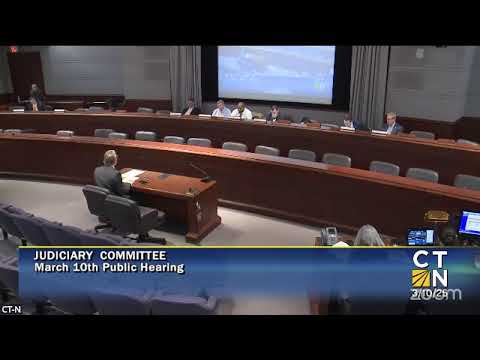
Connecticut judiciary hearing draws wide public comment on proposed hate-crime consolidation bill
Summary
Lawmakers and public witnesses sparred over the governor's proposal to consolidate Connecticut's hate-crime statutes, debating whether the rewrite would help prosecutors or chill protected speech.
Hartford ' Lawmakers and members of the public spent a full hearing on March 10 discussing the governor's bill (HB 68 72) to consolidate Connecticut's scattered hate-crime statutes into a single chapter and to add penalty enhancements for bias-motivated offenses. The bill drew support from state prosecutors and public-safety officials and pushed back hard from advocates, community members and civil liberties groups who warned vague language could chill protest and free speech.
Catherine Baer, executive assistant state's attorney and director of policy development at the Division of Criminal Justice, told the committee the state's current hate-crime laws are fragmented across more than 20 statutory sections and lack uniformity. "A comprehensive review and consolidation of our hate crime statutes into 1 chapter where they're actually called hate crimes with the inclusion of a penalty enhancement, a meaningful penalty enhancement, particularly with respect to our class a and b felonies, is long overdue," Baer said.
Ronnell Higgins, commissioner of the Department of Emergency Services and Public Protection, said consolidation would help law enforcement and that Connecticut has seen an increase in reported bias incidents in recent years. "This bill will consolidate and strengthen the state's existing hate crime statutes," Higgins said, noting an increase in reported incidents since 2021.
Public commenters were divided. Several residents and activists urged caution and asked lawmakers to tighten definitions and remove or rework language they said could be used to suppress dissent, particularly in the context of protests related to the Israel'Palestine conflict. Suhail Locanwalla, who said he had testified in opposition, warned the measure could be used to punish certain political expression and "criminalize the urging and advocating of individuals that commit violence," arguing some provisions were too vague.
Others, including speakers identifying as members of the Jewish community, expressed concern about conflating political criticism of Israel with antisemitism and urged clear definitions to protect legitimate criticism. Jonathan Mann, a member of the Hartford Jewish Organizing Collective, said the law must make clear that criticism of a nation or political ideology is distinct from hate crimes against Jewish people.
Opponents also flagged the bill's mask language, which would increase penalties when a bias-motivated crime is committed while the perpetrator's face is concealed. Several speakers said the provision could chill public-health mask use and anonymous participation in protests. Testimony from people such as Leora Madison described personal reasons for mask use tied to disability or health concerns; others pointed to a risk of selective enforcement.
Supporters emphasized practical problems prosecutors and police face under the current statutory scheme. Professor Sashwin Pandya, who worked on drafting the consolidated bill as part of the Hate Crimes Advisory Council, said consolidation would put all hate-crime provisions in one place so police and prosecutors can find and apply them. "If you put all the hate crimes in 1 place in the penal code, they'll be easier to find," he told the committee.
Several attorneys, public defenders and constitutional law observers questioned aspects of the draft'particularly mandatory minimums and the precise wording of motive standards such as "motivated in whole or substantial part." Committee members asked how the proposed language would be applied to borderline cases (for example, whether a single insult tied to a victim's age would meet the standard) and whether mandatory enhancements could have the unintended effect of encouraging plea bargaining that would avoid the enhanced charge.
The hearing included many other speakers who urged the committee to send the bill back for amendment rather than advance the measure in its current form. Civil rights organizations and individuals urged clarifying definitions for protected categories, limiting use of mask-based enhancements, and adding training and oversight components for law enforcement to reduce the risk of selective enforcement.
No committee vote occurred at the hearing. Multiple witnesses suggested modest, targeted edits (for example, clarifying the mask provision to focus on intent to conceal identity, or specifying which property and objects the desecration provisions address) to reduce constitutional risk while preserving the bill's aim to make hate-crime law clearer and available for serious offenses.
The hearing made clear that supporters and opponents largely share a goal of reducing bias-motivated violence but disagree about whether the proposed consolidation as drafted best achieves that goal.
Many witnesses recommended further drafting work and cross-agency discussion before a committee decision; committee leadership said those conversations would continue as the bill moved through the process.