Get email alerts on the Job Training topic
No spam. Unsubscribe anytime.
Senate panel hears appropriation request for Twin Cities Rise pay-for-performance workforce program
Summary
Senate File 19-32 would provide one-time funding to Twin Cities Rise to expand its pay-for-performance career pathways; proponents said the model yields significant income gains and high retention among graduates.
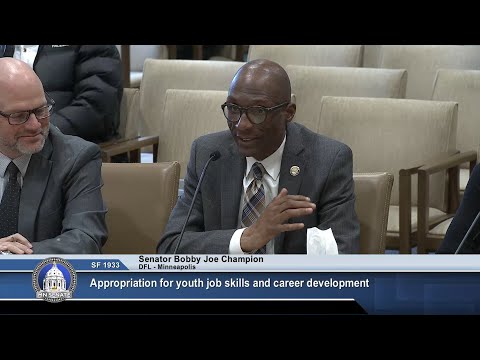
Senate File 19-32, a request for funding to support Twin Cities Rises pay-for-performance workforce model, was presented to the Senate Committee on Jobs and Economic Development. The bill requests one-time appropriations of $1,000,000 in FY2026 and $1,000,000 in FY2027 from the Workforce Development Fund to expand career training and placements.
Senator Champion, sponsor of the bill, and a DEED fiscal analyst reviewed the request and prior funding: Twin Cities Rise previously received $1,400,000 from the Workforce Development Fund in FY2022-23 and $2,400,000 in FY2024-25 from the General Fund. Emma Corey, president and CEO of Twin Cities Rise, described the organizations model: participants called "risers" receive personal empowerment and career training tailored to employer partners; Twin Cities Rise reports an average annual income increase of nearly $30,000 for participants and a one-year retention rate of 76%.
A program graduate, Quentin Osgood, testified about his path from incarceration to long-term employment and work as a program facilitator. Committee members asked about the statutory definition of "pay-for-performance" jobs; Corey said the state requires those jobs to be full-time, benefit-paying positions and that qualifying jobs are specified in statute (the committee was not given a statute citation in the hearing). She listed employer partnerships that drive specific career pathways, such as diesel technicians (Minnesota Trucking Association), call center roles (Target), and facilities/maintenance jobs with the Minnesota Public Housing Association.
Senator Champion closed by urging support for the bill and noting its return-on-investment claims. The committee laid Senate File 19-32 over for possible inclusion; no vote was taken.
AI generated
The text on this page is AI generated. Summaries, highlights, analysis, and video transcripts are all produced from the original source material.
AI can make mistakes, so if you spot one, and we will fix it for everyone.
Note: the source content is unaltered by us. Any content source we link to, be it a video, an audio recording, or a document, is presented exactly as its publisher released it. That publisher is usually a government body, sometimes an individual official or another organisation.