Get Full Government Meeting Transcripts, Videos, & Alerts Forever!
Senate committee hears hours of testimony on SF 1142 net‑metering changes and lays bill over
Summary
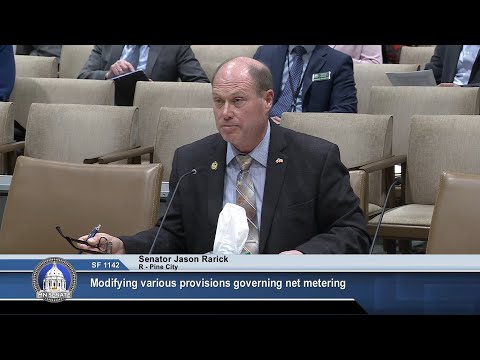
Senators and more than two dozen testifiers debated Senate File 1142 on March 10, 2025, in the Minnesota Senate Environment and Climate Committee. The bill, carried by Senator Grant Rehrig, would change how customers with rooftop or small distributed solar are compensated for annual excess generation on cooperative and municipal systems, replacing retail compensation with an avoided‑cost payment.
Senators and more than two dozen testifiers debated Senate File 1142 on March 10, 2025, in the Minnesota Senate Environment and Climate Committee in Room 1150. The bill, carried by Senator Grant Rehrig, would change how customers with rooftop or small distributed solar are compensated for annual excess generation on cooperative and municipal systems, replacing retail compensation for annual excess credits with an avoided‑cost payment.
The change, Rehrig told the committee, is aimed at addressing what he called an inequity when customers who do not have solar effectively subsidize those who overproduce: “What has happened ... because of the way folks are compensated for over generation, we are starting to see folks who are building are starting to purposely overbuild their needs,” he said. The bill would keep the 40‑kilowatt net‑metering cap but alter how annual excess is valued, defining avoided cost in a way that varies by utility rather than listing a single statewide number.
Why it matters: supporters say the change restores fairness for member‑owned utilities and their non‑solar customers; opponents say it threatens jobs, investment and rural rooftop and small‑wind generation and that the draft lacks data and protections for existing projects. Commerce testified it does not oppose the bill’s premise but urged more analysis and recommended grandfathering of projects with pending interconnection applications.
What the bill would do
• Replace retail compensation for annual excess generation on co‑ops and municipals with an avoided‑cost payment that varies by utility rather than a single statutory…
Already have an account? Log in
Subscribe to keep reading
Unlock the rest of this article — and every article on Citizen Portal.
- Unlimited articles
- AI-powered breakdowns of topics, speakers, decisions, and budgets
- Instant alerts when your location has a new meeting
- Follow topics and more locations
- 1,000 AI Insights / month, plus AI Chat