Get Full Government Meeting Transcripts, Videos, & Alerts Forever!
Get email alerts on the Net Metering Sf1142 topic
No spam. Unsubscribe anytime.
Senate committee hears hours of testimony on SF 1142 net‑metering changes and lays bill over
Summary
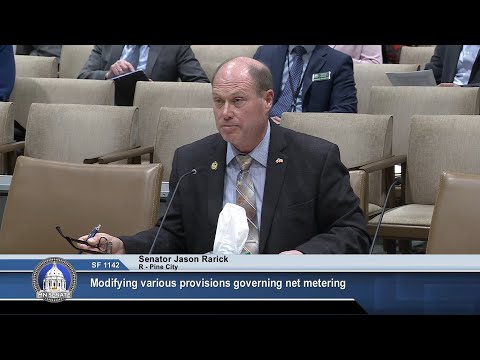
Senators and more than two dozen testifiers debated Senate File 1142 on March 10, 2025, in the Minnesota Senate Environment and Climate Committee. The bill, carried by Senator Grant Rehrig, would change how customers with rooftop or small distributed solar are compensated for annual excess generation on cooperative and municipal systems, replacing retail compensation with an avoided‑cost payment.
Senators and more than two dozen testifiers debated Senate File 1142 on March 10, 2025, in the Minnesota Senate Environment and Climate Committee in Room 1150. The bill, carried by Senator Grant Rehrig, would change how customers with rooftop or small distributed solar are compensated for annual excess generation on cooperative and municipal systems, replacing retail compensation for annual excess credits with an avoided‑cost payment.
The change, Rehrig told the committee, is aimed at addressing what he called an inequity when customers who do not have solar effectively subsidize those who overproduce: “What has happened ... because of the way folks are compensated for over generation, we are starting to see folks who are building are starting to purposely overbuild their needs,” he said. The bill would keep the 40‑kilowatt net‑metering cap but alter how annual excess is valued, defining avoided cost in a way that varies by utility rather than listing a single statewide number.
Why it matters: supporters say the change restores fairness for member‑owned utilities and their non‑solar customers; opponents say it threatens jobs, investment and rural rooftop and small‑wind generation and that the draft lacks data and protections for existing projects. Commerce testified it does not oppose the bill’s premise but urged more analysis and recommended grandfathering of projects with pending interconnection applications.
What the bill would do
• Replace retail compensation for annual excess generation on co‑ops and municipals with an avoided‑cost payment that varies by utility rather than a single statutory number. Rehrig said avoided cost must differ by cooperative or municipal because “they all have different contracts for purchasing their energy” and usage levels.
• Maintain the 40 kW cap on net‑metered facilities but revise capacity definitions tied to point of connection and system sizing. Rehrig said the 40 kW cap aligns with common transformer sizing at the service connection.
• Not require customers to add battery storage to participate; under current draft customers would still inject generation to the grid and draw from the grid when needed.
Supporters’ case: cost and fairness
Witnesses from electric cooperatives and municipal utilities told the committee the current retail compensation shifts costs to non‑solar customers. Tim Sullivan, president and CEO of Wright‑Hennepin Cooperative Electric Association, said the cooperative last year paid roughly retail to a small group of members and estimated a quarter‑million dollars in costs borne by other members. “This bill will return at least some fairness to a net metering system that now allows a few to profit at the expense of the many,” he said.
Dan Carlisle, CEO and general manager of Todd‑Wadena Electric Cooperative, described budget pressures and said his cooperative had to buy excess energy at higher prices last year: “I have to try to explain why I bought electrons for $70,000 from 47 systems that produced excess energy … when I could have purchased those electrons for around $30,000,” he said.
Bill Black, representing the Minnesota Municipal Utilities Association, told senators the bill is “surgical” and would not punish small generators but would prevent rate pressure on municipal customers as renewable mandates increase.
Opponents’ case: impacts on adoption, jobs and existing investors
Farmers, solar installers, trade groups and advocates urged caution or rejection. Multiple small business owners and rooftop installers said the proposal would crush nascent local solar markets and cost jobs. Kim Benjamin, owner of Solar and Mower, warned that a similar change in California resulted in rapid job losses and said Minnesota’s rooftop penetration remains low: “If this bill goes through as it’s wrote it will crush solar in Minnesota,” she said.
Advocacy groups including Vote Solar, Sierra Club volunteers, Solar United Neighbors and the Minnesota Solar Energy Industries Association urged more study. Patty O’Keefe of Vote Solar said the bill “would have a chilling effect on solar in co‑op territories resulting in less solar overall, fewer bill savings and the removal of a crucial tool for rural wealth building.”
Several speakers argued that existing customers made investments under current rules and asked for grandfathering of projects already in the interconnection queue. Sam Smith of the Minnesota Department of Commerce said the department “does not disagree with the basic premise driving this bill” but expressed concern that the draft does not include a grandfathering clause and cautioned a change could disincentivize storage or larger systems that might be needed in future.
Technical issues and capacity definition
Engineers and developers raised technical objections to the bill’s capacity definitions and alignment with regional market rules. Alex Gast, COO of Cedar Creek Energy, warned the draft’s capacity language would not align with MISO definitions and could force customers into unavailable inverter products. Griffin Dooling of Blue Horizon Energy said the redefinition “would take us out of alignment with existing engineering practice, out of alignment with MISO,” making some projects impractical.
Fees, transparency and data
Multiple testifiers said utilities already levy grid access or solar fees that reduce customers’ net benefit, and several asked for transparent data showing whether a cost shift exists and how large it is. Michael Allen of All Energy Solar presented firm data on the sample of his customers and said many utilities collect more in fees from solar customers than they pay out in excess generation. Other witnesses urged a formal study before broad statutory change.
Member questions and committee action
Committee members pressed for compromise language, grandfathering and more data. Senator Rehrig and other members said they intend to continue stakeholder meetings. After extended testimony and member discussion, the committee laid S.F. 1142 over for further work; no final vote on passage occurred. The hearing ended with the chair stating: “With that, Senate File 11‑42 is laid over, and we are adjourned.”
Ending note
Senators and stakeholders signaled the issue will pause for more stakeholder negotiation, data requests and technical fixes, particularly around grandfathering, capacity definition and avoided‑cost calculations. The committee signaled willingness to continue the conversation rather than advance a final bill at this hearing.