Get Full Government Meeting Transcripts, Videos, & Alerts Forever!
Get email alerts on the K 12 Assessment topic
No spam. Unsubscribe anytime.
Senate committee hears bill to replace high‑school MCAs with ACT or SAT
Summary
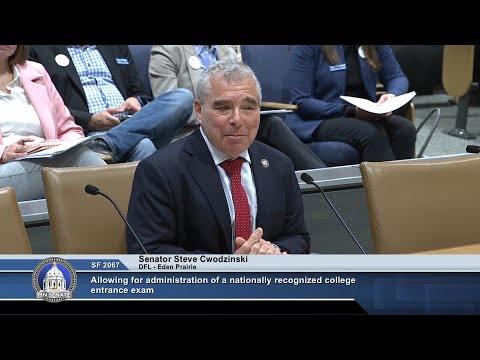
At a Minnesota Senate Education Committee hearing, members took testimony on Senate File 2067, a bill that would allow a nationally recognized college‑entrance exam such as the ACT or SAT to satisfy state and federal testing requirements now met by the Minnesota Comprehensive Assessments (MCAs).
At a Minnesota Senate Education Committee hearing, members took testimony on Senate File 2067, a bill that would allow a nationally recognized college‑entrance exam such as the ACT or SAT to satisfy state and federal testing requirements now met by the Minnesota Comprehensive Assessments (MCAs).
The bill’s sponsor, Senator Swazinski, moved the A1 amendment and the committee approved the amendment by voice vote. The committee laid Senate File 2067 over for further consideration.
Why it matters: Witnesses told the committee that high‑school participation in MCAs has fallen sharply and that many students and families view the MCAs as irrelevant to postsecondary goals. Supporters argued a national college entrance exam would reduce testing time, improve student engagement and provide data that matters to both students and districts.
Supporters included school board members, district superintendents, the Minnesota PTA, representatives of ACT and College Board, and students. Laura Oksnavad, a school board member testifying for the Association of Metro School Districts and the Minnesota School Board Association, said the MCAs “were designed to measure system performance rather than individual student achievement” and argued lawmakers should “consider transitioning to a single accountability measure aligned to state standards that evaluates both systems and individual students.”
Eden Prairie Schools Superintendent Dr. Josh Swanson told the committee that the district sees very low participation on the high‑school MCAs: “In Eden Prairie, only 30% of our students actually take the math MCA, meaning 70% of our students opt out.” He added that over 95% of Eden Prairie students voluntarily take the ACT and that continuing to invest in an assessment “that students and families actively avoid is really a misuse of valuable state resources.”
Student witnesses described test fatigue and scheduling pressure from overlapping spring exams. Sienna Obel, a senior at Eden Prairie High School, said MCAs “should no longer be a required assessment in Minnesota public high School” and that students already face AP exams, SAT/ACT, PSAT and other end‑of‑year assessments.
Bloomington Public Schools’ executive director of research, Dr. Julio Caesar, described a multi‑year drop in participation and noted the federal Every Student Succeeds Act (ESSA) allows states to use a nationally recognized assessment for accountability. He said an alignment study conducted with ACS Ventures found that “100% of ACT reading items and 93% of ACT math items align with Minnesota standards.” He also stated that “Under ESSA, states have the flexibility to utilize a nationally recognized assessment just as the SAT or the ACT in place of their state developed assessments.”
Representatives of test vendors described support services and accommodations. Jeremy Willie, ACT’s director of state partnerships for Minnesota, said ACT offers district‑testing windows and accommodations and that “96 percent of public and charter schools across Minnesota offer district testing through ACT.” Kevin McHenry, director of government relations for College Board, said the College Board supports an open procurement process if Minnesota selects a national exam and described SAT resources such as free Khan Academy prep.
Opponents and skeptics cautioned against outsourcing alignment and oversight to national vendors and warned of equity and access concerns. Matt Shaver of Ed Allies testified that Minnesota’s MCAs are aligned to state standards developed through a decennial revision process with Minnesota educators, and he warned that “swapping out the MCA for the ACT or SAT flips this dynamic on its head” because a national vendor determines what is tested.
Committee action: Senator Swazinski moved the A1 amendment and the amendment was approved by voice vote. Later in the hearing the committee laid Senate File 2067 over for possible further action.
What’s next: The bill was laid over by the committee; committee members asked for additional information, including cost comparisons, details on accommodations and technical alignment studies. No final policy decision was made at the hearing.