Get Full Government Meeting Transcripts, Videos, & Alerts Forever!
Get email alerts on the Municipal Utilities topic
No spam. Unsubscribe anytime.
Committee advances bill letting cities expand municipal utility commission size
Summary
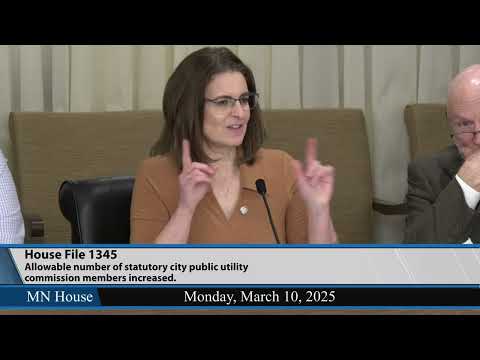
The Elections, Finance and Government Operations Committee on a motion laid over House File 1345, a bill to allow statutory cities to increase the size of municipal public utility commissions from three members to five or seven and to permit up to two city council members to serve on larger commissions.
The Elections, Finance and Government Operations Committee on a motion laid over House File 1345, a bill to allow statutory cities to increase the size of municipal public utility commissions from three members to five or seven and to permit up to two city council members to serve on a five- or seven-member commission.
The measure, carried by Representative Rearick, was introduced with testimony from Buffalo city officials and the Minnesota Municipal Utilities Association. Taylor Groenau, city administrator for the city of Buffalo, told the committee the city owns and operates electric, water, sewer and fiber utilities that together have a budget of just over $37,000,000 and make up about 58% of the city's overall budget. Groenau said a larger commission would better match the size and complexity of such systems.
"Given the size and complexity of our municipal utilities, we believe a larger commission is appropriate for our situation," Taylor Groenau, City Administrator, City of Buffalo, said in testimony.
Ken Sewell, government-relations staff for the Minnesota Municipal Utilities Association (MMUA), said MMUA vetted the proposal quickly and that the oral amendment offered by the author addressed the group's principal concern about giving local actors an easy route to ‘‘pack’’ a commission. Sewell described prior cases in which governance changes produced contested results and said the amendment helps preserve oversight balance.
Nonpartisan staff read an oral amendment offered by Representative Rearick that, in effect, inserts the text: "for a commission with 3 members, and no more than 2 members may be chosen from the council membership for a commission with 5 or 7 members." Committee members voted in favor of the amendment.
Committee members discussed safeguards against both ‘‘packing’’ by councils and sudden local reductions in commission size. Representative Acum said there had been an instance in the past where a commission was effectively packed after a series of political changes; Ken Sewell described that history as a cautionary example. Representative Coulter asked why a city might seek to decrease the commission size and expressed interest in language that would limit opportunistic changes by councils.
Representative Rearick said the bill is intended to provide statewide flexibility to the roughly 58 to 61 municipal PUCs that exist in Minnesota rather than require individual special legislation. The author and witnesses indicated they would continue to refine paragraph C of the bill to clarify oversight and procedures.
On motion from the author, the committee laid House File 1345 over for further discussion and drafting to address the remaining concerns in paragraph C.
Votes and formal actions recorded during the item included adoption of the oral amendment and the motion to lay the bill over for further work; the committee did not record a roll-call tally in the transcript.
The bill will return for additional review after the author and nonpartisan staff incorporate the committee’s suggested language changes and clarifications.