Get Full Government Meeting Transcripts, Videos, & Alerts Forever!
Get email alerts on the Rail Safety topic
No spam. Unsubscribe anytime.
Minnesota senators consider law to let MnDOT expand state rail inspectors from six to 10
Summary
A bill by Sen. Kupik would authorize Minnesota to increase its complement of state rail inspectors from six to 10 as a contingency against potential federal staffing cuts; supporters cited safety concerns, industry witnesses disputed an imminent federal cut and raised other threats to rail safety funding.
Sen. Kupik introduced Senate File 1171 to the Minnesota Senate Transportation Committee on March 10, 2025, asking the panel to authorize the Minnesota Department of Transportation (MnDOT) to increase the number of state rail inspectors from six to 10.
The bill’s sponsor said the change is intended as a contingency in case of cuts to federal rail safety staff. “We are just not sure what the federal government is planning and doing in terms of potential cuts to rail inspectors,” Sen. Kupik said, arguing that Minnesota communities with frequent freight traffic need additional assurance that equipment and track are safe.
Joel Mueller, representing the Brotherhood of Locomotive Engineers and Trainmen, testified in favor of the bill. Mueller said railroads have cut personnel and used less-trained employees for inspections, and that “this trend is a direct consequence of an industry prioritizing efficiency over safety,” adding that defects have been returned to service without repair and pose risks to workers and the public.
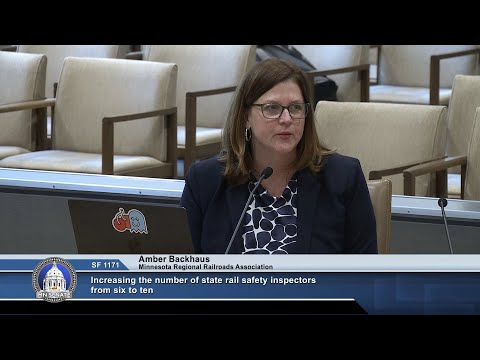
Amber Backus, representing the Minnesota Regional Railroads Association through United Strategies, told the committee she appreciates the conversation but does not believe the Federal Railroad Administration’s (FRA) safety inspector ranks are presently at risk. “According to FRA staff, inspectors were exempt from the deferred resignation program due to their role in protecting public safety,” Backus said, and she noted that railroads have substantially increased automated, wayside inspections in recent years.
Backus also warned of a separate federal funding risk: she told the committee that about $10 million in federal railroad crossing elimination grants awarded to Minnesota in January are on hold under the new administration and could be rescinded, threatening projects in Minneapolis, Hermantown, La Crescent, Anoka, Saint Paul, Becker, Alexandria and Moorhead that were counting on that funding to improve grade crossings.
A MnDOT fiscal analyst, Ms. Boyd, summarized the department’s fiscal note saying the bill would show a net-zero effect on the state general fund but would authorize one additional full-time equivalent (FTE) inspector hire per year beginning in fiscal 2026, reaching four new FTEs by 2029. MnDOT would recover the costs through assessments on rail carriers, Ms. Boyd said. Committee members asked whether the “adjusted rate” shown in the fiscal note reflected overtime or overhead; an outside analyst, Eric Rudine, clarified that the adjusted rate represented overhead (for example, benefits and other employer costs).
Committee debate ranged from strong support for a contingency plan to objections about adding cost to rail carriers. Several members said Minnesota already has a robust safety program; others said a statutory cap is appropriate because carrier assessments fund the positions and the state should be able to plan if federal staffing declines. MnDOT staff described how state and federal inspectors “complement each other,” and MnDOT staff said current state inspectors are based in St. Paul and cover the state, with some disciplines splitting territory.
The committee took no final vote to advance the bill on March 10; the chair laid Senate File 1171 on the table for possible inclusion in a future bill.
The committee record shows the bill was presented, discussed at length, and paused for further consideration by MnDOT and legislators rather than advanced to final action at this hearing.