Get Full Government Meeting Transcripts, Videos, & Alerts Forever!
Get email alerts on the State Fraud Overview topic
No spam. Unsubscribe anytime.
House committee hears overview of statewide fraud; Feeding Our Future singled out as largest case
Summary
A House panel heard a presentation summarizing alleged fraud, waste and abuse in Minnesota programs since 2019, with the Feeding Our Future investigation the largest single matter discussed. Members debated the presenter’s dollar estimates and discussed steps to strengthen cross‑agency oversight.
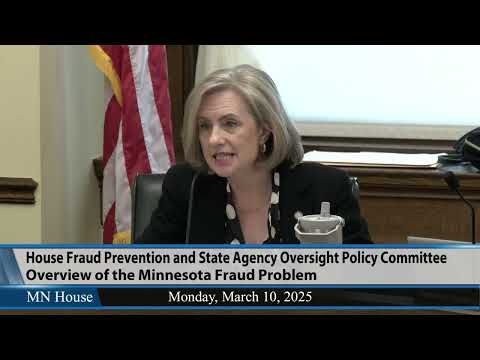
The House Fraud Prevention and State Agency Oversight Committee heard a presentation in March 2025 from Bill Gaughan, a fellow at the Center of the American Experiment, who said Minnesota "has a fraud problem," and summarized a public tracker that lists roughly $611 million in alleged fraud, waste and abuse across state programs since 2019.
Gaughan told the committee the largest single matter is the federal Feeding Our Future investigation, which U.S. prosecutors have described as involving roughly $250 million; he said his review of related corporate dissolutions and additional organizations suggests the overall loss connected to the food programs could be substantially higher. He described other cases on the tracker, including a Medicaid transportation and interpreter fraud prosecution nicknamed “Pit Stop 66,” alleged overbilling in addiction recovery providers, and questions about the Child Care Assistance Program (CCAP).
The topic matters because the cases involve taxpayer-funded programs that deliver services to low‑income residents: school and USDA food programs, Medicaid, child care subsidies and pandemic-era frontline‑worker payments. Several members pressed Gaughan on how the tracker’s dollar totals were calculated and whether some figures represent alleged loss, payments made to organizations, or amounts later recovered.
Gaughan summarized his tracker and the Feeding Our Future case. He said federal indictments in that case accused defendants of diverting about $250 million, pointed to dozens of additional indictments and to civil suits by the state attorney general that led to corporate dissolutions, and said "by my research, I think the total number for the food fraud probably is double that, around 500,000,000." He also told the committee that prosecutors had recovered only a fraction of that amount — he cited various public estimates in the tens of millions — and described practical obstacles to full recovery, including overseas transfers and cryptocurrency.
Other items Gaughan discussed included: - CCAP and childcare subsidies: Gaughan cited prior auditing and reporting that raised concerns about providers that billed significant sums but were not observed to be operating on-site during media checks. Committee members noted CCAP has seen recoveries in the low millions compared with much larger disbursements. - Medicaid provider fraud (Pit Stop 66): Gaughan detailed a case the state attorney general prosecuted involving coordinated billing for interpreter, transportation and provider services in the Faribault area; he described tactics alleged in indictments such as billing multiple times for single rides and using identity information to bill for appointments that did not occur. - Addiction-recovery providers: Gaughan referenced ongoing criminal and civil actions against providers (Evergreen Recovery and related cases), including recent FBI searches and indictments of executives alleging overbilling to Medicaid.
Gaughan urged an "enterprise‑wide" response to prevent money from leaving state coffers in the first place, rather than relying primarily on later civil or criminal recovery. He said agencies currently operate in silos and recommended several reforms: a universal flagging or “do not fund” list for entities adjudicated to have committed fraud, requiring organizations to file at least one year of IRS Form 990 information before receiving state grants, clearer registration for entities that operate almost entirely on government contracts, and tightening conflicts‑of‑interest rules (for example, limiting elected officials from serving on boards of organizations that receive state funding). He described policy options including creating an inspector general for the executive branch or expanding the powers of the elected state auditor.
Committee members welcomed parts of the presentation and pressed Gaughan on methodology. Representative Irene Pinto (chair) and others challenged the use of some historical figures and said several numbers in Gaughan’s tracker came from different sources with divergent conclusions. Pinto pointed to the Office of the Legislative Auditor (OLA) report cited in the tracker and noted the OLA had found some earlier investigator allegations unsubstantiated in the same report. Other members called for additional witnesses from prosecuting offices and agency fraud units; Rep. Michael Greenman and others suggested inviting assistant attorneys general or Department of Human Services investigators to appear in future hearings.
The committee conducted one formal vote at the start of the meeting: members approved the minutes of the March 3, 2025 meeting by voice vote after Vice Chair Anderson moved their adoption.
Committee members did not adopt formal legislation at this meeting. Several members asked staff to pursue follow-ups, including inviting state and federal prosecutors and agency fraud investigators to testify at future hearings and compiling specific statutory or administrative changes to consider in the coming session.
The presentation prompted contested points of fact and method: some members called the tracker’s totals "cherry‑picked" and warned against using an aggregate figure without standardized methodology; others said the presentation raised important policy options for hardening state grant and contract processes. The committee indicated it will hold additional hearings to examine specific cases, recovery efforts and potential statutory changes to grants management and cross‑agency information sharing.
Votes and formal actions at the meeting were limited. The committee concluded with the chair adjourning the hearing and reserving additional time for follow-up witness invitations and staff work on draft proposals.